07. Choosing a Hospital and Doctor

    When one must drive a gravely ill person or a woman in labor to the hospital, he should drive to the nearest hospital, in order to avoid additional Shabbat desecration. Even if there are better hospitals available, for routine matters, like births and treatment of injuries and common diseases, there is no significant difference between hospitals, so one drives to the closest one. Even if the patient or woman in labor prefers a more distant hospital because it is cheaper, has nicer rooms, or is more conveniently located for relatives who will wish to visit, since these are not medical considerations, one may not drive farther on Shabbat for any of these reasons. Similarly, if a woman is away from home for Shabbat and goes into labor, she should go to a local hospital.

    When a case is more complicated and there is a medical reason to prefer a more distant hospital, one may drive there on Shabbat. For example, if the more distant hospital specializes in the treatment of the patient’s illness, or if the illness is complex, and the more distant hospital is already familiar with the patient and will therefore be able to provide the appropriate treatment more quickly, one may drive the patient there. So too, if a woman’s pregnancy is considered high-risk, and the distant hospital has a protocol in place for her needs, one may drive her there on Shabbat. Everything should be done in accordance with accepted medical recommendations. The more complicated and difficult the case, the farther one may travel to ensure the best care. Thus, if there is only a slight medical advantage, one may travel only slightly farther to gain that advantage. After all, during the week, sick people and women in labor are not advised to travel long distances to the best hospitals for every minor medical issue. So too on Shabbat, they may not travel farther to reach the best hospitals, since accepted medical recommendations do not demand it.

    If a woman in labor claims that she will receive better medical care at a more distant hospital, even if her claim has no realistic basis, one may drive a bit farther in order to ease her mind, but not a lot farther. Even when one may extend the drive for a medical reason, it must remain within reason.

    In general, it is preferable to go to a hospital that operates in accordance with halakha. On Shabbat, one may travel slightly farther in order to reach such a hospital. This way there will be less Shabbat desecration in the hospital, and the patient will feel more comfortable. However, one should not travel much farther for this purpose.[7]


    [7]. If the more distant hospital has a medical approach that is more compatible with the patient’s or pregnant woman’s outlook (for example, a preference for natural childbirth over Caesarean sections), one may travel farther to get there. However, since this is not a clear advantage, and in most cases this difference in outlook does not come into play, one should not travel much farther to reach the preferred hospital for this reason.According to R. Eliezer Waldenberg, if there is no medical reason to prefer a more distant doctor, but the patient believes that the distant doctor is better, one must listen to the patient and call the preferred doctor, even when it involves additional Shabbat desecration (Tzitz Eliezer 13:55-56). As the Yerushalmi states: “A person does not merit to be healed by just anyone” (y. Nedarim 4:2). He also infers this from AZ 55a, which speaks of suffering resulting from the treatment of a particular doctor. Therefore, one must listen to a patient who demands a specific doctor. SSK 32:38 states similarly, as does R. Yitzĥak Zilberstein (Torat Ha-yoledet 7:2), who adds that if a woman in labor feels that the standard of medical care is better in the more distant hospital, one may travel there. He cites R. Scheinberg (n. 4) as saying that under normal circumstances, one should rely on the nearest hospital since we do not allow additional Shabbat desecration in order to put the patient’s mind at rest unless it is a situation where the Sages tell us that if we do not ease his mind, he will be in danger.

    In my opinion, if there is no substantive medical reason to prefer the more distant hospital, but nevertheless the patient feels that the distant hospital is medically superior, one may travel a little farther, but not much farther. The reason for this is that for a dangerously sick person, we do everything on Shabbat that we would do during the week (Rambam; SA 328:3). However, going beyond this is overly indulgent. During the week, medical opinion is that it is proper to travel a little farther to ease the mind of a gravely ill person or a woman in labor, but that there is no need to travel much farther. A possible support for this position appears in another area of Shabbat law: during the course of a circumcision, one may cut away bits of skin that do not invalidate the circumcision, even though cutting them off on Shabbat would otherwise be prohibited by Torah law (Shabbat 133b; SA 331:2). This is because once circumcision overrides Shabbat, everything that is part of the circumcision process overrides it as well (Rashi). Thus, arguably, once one may travel on Shabbat, one may extend the trip a little to get to the hospital that the patient thinks is medically superior. However, to extend the trip greatly would mean that the patient would no longer view the extra travel as an addition to the basic trip but rather a separate trip – which may be undertaken only if it may save a life. In contrast, if the patient concedes that the more distant hospital is not medically superior, but he just has a better feeling about it, the trip should not be extended at all. See Torat Ha-yoledet ch. 7, end of n. 4. We should add that in the case of a complex illness, there can sometimes be a medical advantage if the patient is personally acquainted with a member of the medical staff.

    1. Zilberstein points out that one should not increase travel time in order to reach a hospital just because it has higher kashrut standards. However, if the more distant hospital will make a point of minimizing Shabbat desecration, it may be that it is preferable to travel to it, because of the principle (Menaĥot 63b, 72a) that it is better to transgress one melakha many times than several melakhot a few times each (Torat Ha-yoledet 7:3-4). We should add that it also may be that the sick person has more confidence in the medical staff at the religious hospital, in which case one may travel a little farther to reach it.

    If a woman in labor tells an ambulance driver that she prefers the more distant hospital because she feels that it is medically superior, but the real reason for her preference is so that her family will be able to visit her, the resulting Shabbat desecration is her responsibility, since the driver has no way to know that she is lying. From his perspective, this may be a case of saving a life, on account of which one desecrates Shabbat.
    08. Accompanying a Sick Person or Woman in Labor to the Hospital

    A patient who is rushed to the hospital generally needs a chaperone, to offer support and to ensure that he is given proper care by the medical staff. Unfortunately, due to heavy volume of patients at a hospital, patients who are alone are sometimes overlooked. Therefore, if a family finds out that a relative has been hospitalized with a serious injury or illness and is alone in the hospital, one of the family members must travel there, even on Shabbat.

    Similarly, a woman in labor must be accompanied to the hospital. Even if she does not request, someone – her husband, mother, or doula – should travel with her. If the woman in labor or the patient arrives at the hospital without a chaperone, it is permitted to call someone to travel to the hospital. Even though caring for a woman in labor is straightforward and familiar, there is still a concern that she will panic and endanger herself. Therefore, one may desecrate Shabbat on her behalf and do whatever he may do for a dangerously sick person (SA 330:1; MB ad loc. 3; BHL s.v. “u-madlikin”).

    Recently, some women request the presence of both their husbands and their mothers at the hospital. Some also ask their doulas to attend. Since this is not a lifesaving medical necessity, only one chaperone may travel along – her husband, her mother, or her doula. Only in an unusual circumstance, such as when a woman becomes hysterical and insists that both her husband and her mother must accompany her, may they both do so. Similarly, if she experiences anxiety and demands that they call her doula, the doula may be called. Nevertheless, one may not plan for more than one person to accompany her on Shabbat.

    Others disagree and maintain that one should do whatever the woman in labor wants, even if she is not hysterical. If she wants her husband, mother, and doula to come with her, they all travel along, to put her mind at ease. According to this approach, one may even make a detour in order to pick them up or call them to request that they make their own way to the hospital. However, this would seem to be excessive, and it does not legitimize driving on Shabbat. The widespread custom is that one person accompanies a woman in labor. However, if the drive is long and the husband is driving, the mother or doula may come along as well, since sometimes another person is needed to help the woman during the drive.

    If the woman in labor has small children at home, one must prearrange for neighbors to care for the children in the event that the parents must travel on Shabbat. However, if they live in a remote location, or if the neighbors are bad or untrustworthy people, with whom it dangerous to leave children, and leaving the children home alone would also be dangerous, the children may travel with the parents to the hospital. One may also make a slight detour in order to drop them off with a family that can take care of them.[8]


    [8]. One may violate Torah prohibitions in order to accompany a sick person or a woman in labor, just as one may light a fire for a woman in labor even when it is not truly necessary (SA 330:1; MB ad loc. 3; BHL s.v. “u-madlikin”). This is even more relevant today, when the generally accepted wisdom is that the patient needs someone to accompany him in the hospital in order to ensure that he receives proper care (Nishmat Avraham, OĤ 278:4 with n. 29, and 330:6 citing R. Yehoshua Neuwirth; R. Yoel Katan in Assia 9). If a non-Jew is available to drive the children to family or friends, one may ask him to do so, even if the neighbors can watch the children in a pinch. If it is not necessary to take a detour or make an extra trip to pick up the mother or the doula, even if the woman in labor is not completely hysterical, if she demands that they travel with her even on Shabbat, they may be picked up in a pinch. However, one may not plan for them to travel with her, because in fact there is no need for more than one person to escort her.

    A woman in labor who wants to rely on the lenient opinion and have two people accompany her must be honest with herself regarding how much she truly needs the extra person. She should imagine that, for example, she went into labor on a Shabbat that her mother or doula happened to be hosting large numbers of guests for a son’s aufruf, when traveling to the hospital would mean deserting her guests until after Shabbat and missing her son being called up to the Torah. If, under such circumstances, the woman in labor would still demand that her mother or doula accompany her in addition to her husband, and they would still agree to go, this indicates that they really do consider their role in her childbirth potentially lifesaving, and they may accompany her according to the lenient opinion. However, if under such circumstances the woman in labor would forego their presence, it indicates that she does not consider their role to be life-saving. Accordingly, even on a regular Shabbat, she should suffice with one chaperone. The ambulance driver does not count as a chaperone, as he will not stay in the hospital with the patient or woman in labor (see Igrot Moshe, OĤ 1:132; Or Le-Tziyon 2:36:23; BHL 330:1, s.v. “u-madlikin”; Yalkut Yosef 330:9). It is proper not to rely on the lenient opinion at all, because adding another chaperone has no lifesaving value; the merit of keeping Shabbat is more effective.

    09. Driving Home on Shabbat

    If the patient is released after it is determined that he is not in danger, he and his chaperones may not desecrate Shabbat to return home. If necessary – for example, if the patient needs rest – he may be transported home by a non-Jewish driver. However, the chaperone may not ride along unless the patient needs help en route (see below, 28:2).

    Similarly, if a woman is rushed to the hospital to give birth and then released after an examination reveals that she is not yet ready to give birth, she may not desecrate Shabbat to return home. In a time of need, if she is still considered sick – for example, if she needs to lie down – she may be driven home by a non-Jew, but her chaperone may not ride along.

    A Jewish ambulance driver from an outlying community, which needs an ambulance for emergencies, may return to his community after transporting a patient to the hospital. However, he may not drive home the patient or his chaperone, as transporting them entails transgressing Torah prohibitions, since their added weight causes the engine to burn more fuel. Even if the prohibition were merely rabbinic, it would still be forbidden for them to ride home with a Jewish driver.[9]

    If a Jewish ambulance driver in a city drives to treat a patient, he may not drive back to the EMT station afterwards on Shabbat. Since ambulances contain two-way radios, the driver can be contacted at his present location if he is needed for another emergency. However, if there is a real need to drive back – for example, if he expects that he will need an additional medic or more medical equipment for his next trip, or if resting at the station will enable him to treat people more effectively later – he may return to the station.

    If an ambulance was summoned to treat someone in grave danger, but before the ambulance arrives another way to rush him to the hospital was found, someone must call and cancel the request for an ambulance, as it may be needed for a patient elsewhere while it continues to a destination where it is no longer needed. Additionally, there is a concern that medical personnel will not take things seriously when they are alerted on Shabbat in the future, thinking that their help might no longer be necessary but that no one has notified them because they do not want to make a phone call on Shabbat.

    If a Jewish driver is transporting a woman in labor to the hospital, and during the drive she says that her contractions have stopped (to the point that, if she were at home, she would not consider going to the hospital), he may not continue driving. He must stop and park in a safe place until Shabbat is over (R. Shlomo Zalman Auerbach). If the ambulance must be returned to the station for reasons of piku’aĥ nefesh, the driver returns to the station, and the woman and her chaperone may remain in the ambulance and return with him.

    A Jewish doctor who is summoned to treat a gravely ill patient may drive to the patient without ascertaining the details, since even the possibility of saving a life overrides Shabbat. Nevertheless, it is preferable that he call to clarify the patient’s state, since it is possible that the clarification will lead the doctor to decide that the trip is unnecessary, and it is preferable to minimize the Shabbat desecration. Even when it is clear that the patient is gravely ill and requires the doctor, the phone conversation is still useful. First, it is possible that the doctor will be able to give specific instructions for how to care for the patient until he arrives. Additionally, it may become clear to the doctor that he needs to bring additional equipment with him.[10]


    [9]. As explained in the next section and in n. 12, the Sages’ permissive ruling that “the end is permitted because of the beginning” applies primarily to doctors, nurses, and emergency medical volunteers, who often need to travel on Shabbat. If we would not make it easy for them to return home, there is a real concern that in the future they will avoid setting out in the first place. In contrast, the Sages were not lenient for the patients themselves and their chaperones because there is no concern that they will hesitate to come in the future. After all, a person will always be concerned about his own health. Moreover, the incidents are infrequent and would not regularly disrupt the patient’s Shabbat rest. However, in a time of need a patient may return home with a non-Jewish driver because one may instruct a non-Jew to perform melakhot that are prohibited by Torah law on behalf of a sick person, even if there is no danger to life (SA 328:17; MB ad loc. 47; below, 28:2). However, there are no grounds for leniency for a chaperone, as his added weight would cause the engine to burn more fuel (Nishmat Avraham 278:4 and n. 47; 330:9). But if the patient requires a chaperone on the trip back, the chaperone may travel with the patient and the non-Jewish driver.

    [10]. The Talmud states in Eruvin 32b that it is preferable for a learned person to transgress a minor prohibition in order to save an unlearned person from unknowingly transgressing a severe prohibition. This is the ruling of SA 306:14 and MB ad loc. 56, which state that one should desecrate Shabbat to save a Jew from apostasy. Based on this, when an ambulance was summoned but an alternative arrangement was made after the request was issued, one should call and cancel the request. Compared to driving on Shabbat, which involves multiple violations of Mav’ir, making a phone call is a less severe transgression. However, R. Shlomo Zalman Auerbach opposes this approach, presenting a strong argument: there is no transgression involved in traveling to save lives, so calling to cancel does not minimize Shabbat desecration (cited in Ha-tzava Ka-halakha 32:1, n. 3). Torat Ha-yoledet ch. 21 n. 2 makes the same point in the name of R. Yosef Shalom Elyashiv. Nevertheless, R. Chaim Pinchas Scheinberg comments there that even those who are undertaking lifesaving work should minimize Shabbat desecration, as MB states in 328:35. It would seem, though, that someone must cancel the request for an ambulance for a different reason: to potentially save another life. There may be someone elsewhere who is gravely ill, and the ambulance will not be available to help him if it is making this unnecessary trip. In addition, a false alarm is likely to cause the emergency medical workers to hesitate in the future, especially if they know that on Shabbat people will not call to cancel the request for a doctor or an ambulance.

    If a Jewish ambulance driver is in the process of driving a woman in labor to the hospital and her contractions stop, he may not continue traveling (R. Shlomo Zalman Auerbach, Minĥat Shlomo 1:91:21; Nishmat Avraham 330:25 and n. 7). However, if he is from an outlying community and must return there with the ambulance, he need not stop to drop off the passengers before he returns to the station. Doing so would require additional violations of Mav’ir with respect to the lights and the engine. Since the passengers are already in the vehicle, they may return with him.

    10. Doctors and Nurses Driving to Work and Back Home on Shabbat

    If a doctor has a shift on Shabbat morning and lives too far away from the hospital to reach it on foot, he must drive to the hospital before Shabbat so he will not have to desecrate Shabbat. Be-di’avad, if he did not drive to the hospital beforehand, he may drive there on Shabbat, since saving a life overrides Shabbat. Nevertheless, if he knows before Shabbat that he will have a shift on Shabbat, he must arrange to spend Shabbat in the hospital or nearby (Igrot Moshe, OĤ 1:131).

    The best solution for doctors and nurses in such a situation is to hire a non-Jewish driver to drive them from their homes to the hospital. This way, these doctors and nurses can enjoy Shabbat in their homes, and then when they need to go to the hospital, they can get there with the help of a non-Jew. Even though the Sages prohibited benefiting from melakha performed by a non-Jew on Shabbat (above, 25:1), they permitted this for the sake of a sick person.[11]

    Doctors and nurses who finish their shifts on Shabbat morning may return home with the help of a non-Jewish driver. The Sages ruled that those involved with saving lives on Shabbat may transgress rabbinic prohibitions in order to return home, so that they will not be tempted in the future to refuse to go in the first place. If they are forced to stay in the hospital until after Shabbat, it will be very upsetting for them and their families, and we are concerned that as a result they will quit their jobs or avoid working shifts on Shabbat.[12]


    [11]. In a place where using a non-Jewish driver is not possible, R. Shlomo Zalman Auerbach says (in opposition to Igrot Moshe) that a doctor may stay at home until he needs to go to the hospital for his shift. When the time comes for him to leave, since it is for a lifesaving endeavor, he may drive to the hospital. Even though it is true as a rule that one should prepare before Shabbat to obviate the need for Shabbat desecration, there is no need to take the very difficult step of spending all of Shabbat away from home, thus harming both his oneg Shabbat and his family time. However, R. Shlomo Zalman Auerbach emphasizes that one should be lenient in this case only if the hospital administration makes serious efforts to prevent unnecessary Shabbat desecration. Therefore, in his opinion, one should not in fact be lenient in this situation nowadays, as it is possible to arrange for a non-Jewish driver. With a non-Jewish driver, one may also be lenient and travel farther than twelve mil, which some say is the teĥum by Torah law (SSK ch. 32 n. 106; ch. 40 n. 71; see the end of the next note).

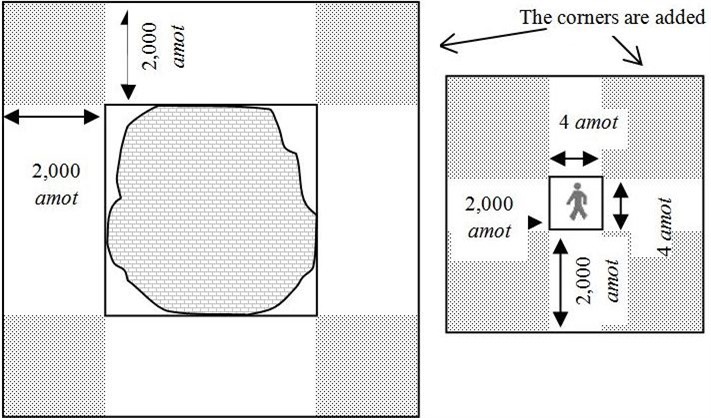
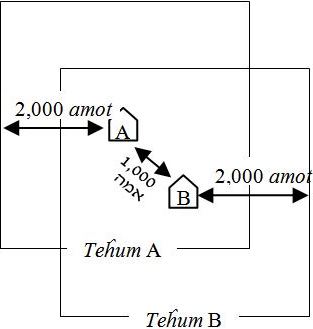
    [12]. The Mishna in Eruvin 44b states that those who set out on a rescue mission outside of the teĥum may travel 2,000 amot in any direction, the same as anyone else at their destination. Tosafot (s.v. “kol”) comment that this is an example of the rationale of “the end is permitted because of the beginning,” where certain actions at the end of an undertaking are permitted in order to ensure that people will be willing to do what needs to be done at the beginning. For instance, if we do not allow the rescuers 2,000 amot of movement, they will hesitate to undertake the rescue mission in the first place. Similarly in RH 23b, the Talmud states that a midwife who traveled beyond the teĥum on Shabbat may then travel 2,000 amot as well. This is the ruling of SA 329:9 and §407. See below, 30:11. Most poskim limit this rationale to rabbinic transgressions (MA 497:18; Tzitz Eliezer 11:39), and they do not always permit these either (Har Tzvi, OĤ 2:10; Minĥat Shlomo 1:8). However, Minĥat Shlomo, Mahadura Tinyana 60:11 permits returning with the help of a non-Jewish driver if it is within twelve mil. Some maintain that when necessary, this principle overrides even Torah prohibitions, to ensure that people will not hesitate before setting out on future lifesaving trips (see Ĥatam Sofer, OĤ 203; Igrot Moshe, OĤ 4:80; Amud Ha-yemini §17). See Ha-tzava Ka-halakha 24 n. 18; Orĥot Shabbat 20:59-61 and Essay 5 at the end of the work; SSK 40:81, 83; Nishmat Avraham 278:4 and n. 47.

    In practice, since it is possible to arrange for a non-Jewish driver to take doctors and nurses back to their homes, under no circumstances should one be lenient and drive home on Shabbat with a Jewish driver. If no non-Jewish driver is available, there is no concern that in the future they will hesitate to go to the hospital in the first place because of this one instance. With a non-Jewish driver, one may be lenient and drive even beyond twelve mil, since according to most Rishonim even this distance is only a rabbinic prohibition (Rosh and Rashba; see below 30:1). In addition, when people are inside a vehicle, the road is a karmelit and the Jewish passenger is not actively doing anything, so there is a strong case to say that even those who are stringent regarding twelve mil would not maintain that any Torah prohibition is involved (see Assia 7, pp. 241-249).

    11. Scheduling Surgeries and Circumcisions on the Days Preceding Shabbat

    Sometimes, one may need to schedule a surgical procedure that will then require follow-up care involving the performance of various melakhot. Similarly, some procedures, such as the extraction of a wisdom tooth, cause pain for several days, which may impair one’s ability to enjoy Shabbat. If the surgery is not urgent, it is proper le-khatĥila to schedule it for the first three days of the week. However, if the best surgeon is only available during the second half of the week, the operation may be scheduled for then, even if it is possible to get an appointment at the beginning of the week with a less expert surgeon (see above, 2:10-11).

    If a woman is due to give birth and her doctors decide that labor should be induced, it may be done on Friday, even though it is reasonable to assume that this will cause her to give birth on Shabbat (SSK 32:33 and the notes).

    If an operation is urgent, it should not be postponed, even if it is possible to postpone it until the beginning of the week. This is because sometimes problems arise, and the surgery may be delayed beyond the time that is medically desirable.

    If a baby boy was sick and his circumcision was delayed, poskim disagree whether the circumcision may be held on a Thursday or Friday. Some argue that since it has already been postponed beyond the Torah-mandated eighth day, the baby should not be circumcised on Thursday or Friday, because in the days following the circumcision he might require care that would involve Shabbat desecration. This is the custom in many Sephardic communities (Tashbetz 1:21; Rav Pe’alim, YD 4:28; Yabi’a Omer, YD 5:23). Others maintain that the likelihood of needing to desecrate Shabbat following the circumcision is not high, and since there is a mitzva to perform the circumcision as soon as possible, one should do so even on Thursday or Friday (Shakh, YD 266:18; MA 331:9). This is the widespread custom among Ashkenazic and Yemenite Jews, as well as some Sephardim.

    12. Fighting Wars on Shabbat

    It is a mitzva to wage a defensive war against Israel’s enemies. This mitzva is even greater than the mitzva of saving human life, as one is not required to risk his own life in order to save the life of another, or even multiple lives. In contrast, it is a mitzva – incumbent upon every individual – to risk one’s life to save the Jewish people from their enemies (Mishpat Kohen §143; Tzitz Eliezer 13:100; see Peninei Halakha: Collected Essays II 11:3).

    Therefore, if enemies attack Israel, it is a mitzva to wage war against them even if this will endanger lives and require Shabbat desecration. Indeed, Rambam rules: “There is a mitzva incumbent upon all capable Jews to come to the aid of their brothers who are under siege, and to save them from non-Jews on Shabbat; they may not delay until after Shabbat…” (MT 2:23). Similarly, if it is known that enemies or terrorists are planning to attack Jews, it is a mitzva to attack them in order to deter them. If there is a strategic objective served by attacking them on Shabbat, we attack on Shabbat (Heikhal Yitzĥak, OĤ 37:3; Amud Ha-yemini §16; see Rema 329:6).

    Furthermore, it is also a mitzva to wage war to prevent future danger, even though doing so will put lives at risk and require Shabbat desecration. This is in accordance with the statement of the Sages that if enemies come to pillage border towns, even if they are taking only straw and hay, “we attack them with weapons and desecrate Shabbat on their account” (Eruvin 45a). We do this because if our enemies know that they can steal without repercussions, they will ultimately end up attacking people. This is also the ruling of Shulĥan Arukh (329:6). Accordingly, it is a mitzva to perform ongoing security operations on Shabbat, to protect our borders from our enemies. Nowadays, the entire country of Israel has the status of border towns with respect to preventing terror attacks (R. Shlomo Goren). Therefore, throughout Israel, it is a mitzva to perform ongoing security operations on Shabbat, to protect life and property.

    If Jews who do not observe Shabbat go on a hike on Shabbat in an area where it is necessary to travel with an armed escort, and there is no way to prevent them from hiking in the first place, it is a mitzva for soldiers to protect them, even if this entails Shabbat desecration. Even though it is the hikers’ Shabbat desecration that creates the need for security, nevertheless, since they are in fact in a dangerous place, they must be protected from the enemy (R. Goren, Meshiv Milĥama 1:7 and 2:110; see Ha-tzava Ka-halakha ch. 21). However, soldiers may not help them desecrate Shabbat. Thus, soldiers may not open checkpoints for them so that they can pass through, give them travel permits, or board their bus to enable them to set out. Only after the group is already underway may soldiers provide security for them.

    Bodies of fallen soldiers may be retrieved from the battlefield on Shabbat to ensure that they do not fall into enemy hands. Even though technically one may not desecrate Shabbat in order to save corpses, since abandoning bodies harms the morale of soldiers, and since Israeli society is willing to free terrorists in order to retrieve bodies captured by the enemy, retrieving them from the battlefield prevents danger to life. After the bodies are recovered, one may not desecrate Shabbat any further to care for the bodies (Meshiv Milĥama vol. 1, p. 61 and 2:117; Ha-tzava Ka-halakha ch. 20).

    The war to conquer the Eretz Yisrael is considered a milĥemet mitzva (obligatory war). Accordingly, when there is a tactical advantage, one may initiate an attack even on Shabbat, as our ancestors did in the days of Yehoshua when they conquered Yeriĥo on Shabbat (y. Shabbat 1:8; Tur, OĤ 249:1).[13]


    [13]. A milĥemet reshut (discretionary war) should not be started on Shabbat, nor on the last three days of the week. However, if a war continues until Shabbat, even if it seems as if it will not hurt the war effort to stop fighting on Shabbat, we do not stop. As the Torah states: “You may cut [trees] down for constructing siege works against the city that is waging war on you, until it has been reduced” (Devarim 20:20). The Sages tell us: “We do not begin a siege against a non-Jewish town in the last three days of the week; but if it was begun, we do not stop. Shammai used to say that ‘until it has been reduced’ means even on Shabbat.” A milĥemet reshut is a war that is meant to extend the boundaries of Israel and increase its power. Such a war is undertaken only by a Jewish king and with the consent of the Sanhedrin (MT, Laws of Kings 5:1-2). It should be noted that in the past, when all monarchies would launch discretionary wars, the monarchy of Israel had to initiate such wars as well, in order to solidify its position. Had it not done so, it would have endangered its long-term survival.In contrast, a war undertaken to conquer Eretz Yisrael is a milĥemet mitzva, as Ramban writes (Hasagot Le-sefer Ha-mitzvot, Hosafot Le-mitzvot Aseh 4). A great many authorities agree with him (see Li-netivot Yisrael vol. 1 ch. 23: “Le-mitzvot Ha-aretz”). At first glance, it seems Rambam believes that conquering Eretz Yisrael is not included in the definition of milĥemet mitzva. However, he too concedes that if an enemy attacks, it is a mitzva to mount a defensive war, both because of the mitzva to settle the land (Devar Yehoshua, OĤ 2:48), and because of the danger to life (Melumdei Milĥama §1). See Ha-tzava Ka-halakha, pp. 7-10.

    In Meshiv Milĥama 1:2, R. Goren analyzes the Gemara’s dictum, “‘until it has been reduced’ means even on Shabbat.” He extrapolates that permission to violate Shabbat for war is even more sweeping than permission to violate Shabbat to save a life. Specifically, a milĥemet mitzva completely suspends (hutra) Shabbat, whereas saving a life only supersedes (doĥeh) Shabbat. When Rambam limits starting a siege to the beginning of the week, he is referring to local battles, but an all-out war has no Shabbat limitations. It is as if Shabbat has been canceled entirely. However, many view the legitimacy of fighting on Shabbat as an expanded form of saving a life, since the soldiers are engaged in saving many lives. Others, based on MT 30:13, maintain that even for a milĥemet mitzva, we do not begin a siege at the end of the week. This is the opinion of Radbaz 4:77. Tur, OĤ 249, states that it is a milĥemet reshut that we do not start in the days preceding Shabbat, but we may start a milĥemet mitzva even on Shabbat itself. The entire disagreement is limited to a case in which there is no tactical advantage to beginning the war on Shabbat; but if starting the war on Shabbat is likely to save lives, then all agree that we may start the war on Shabbat. See Ha-tzava Ka-halakha 25:13, pp. 250-251.

    13. A Commanding Officer’s Authority During Wartime and Normal Times

    During a war, one must do everything possible for the sake of victory, on Shabbat as well. One may not delay matters by referring questions to rabbis, nor should he bother commanding officers by asking them what is or is not necessary. Rather, anything required must be done as quickly as possible.

    In contrast, in normal times, when routine and ongoing security operations and intelligence-gathering are being carried out, Shabbat desecration should be minimized. Only activities meant to prevent life-threatening situations should be undertaken. When possible, it is preferable to use a shinui or another method that renders these actions prohibited on the rabbinic level only. To that end, the military rabbinate of the Israel Defense Forces (IDF) must establish special Shabbat procedures that enable each soldier to carry out his security operations while minimizing Shabbat desecration. Normally, one may not conduct training exercises on Shabbat. Only when forces are on high alert and there is a security need may soldiers be trained for an upcoming operation in which they will participate.[14]

    When things function properly, one may rely on a commanding officer’s familiarity with both security needs and halakha, in accordance with the directives of the military rabbinate. Then, if he gives an order that entails Shabbat desecration, the implication is that it is necessary for security needs and must be obeyed. However, when there is reason to distrust the officer – whether because he does not take the rabbinate’s directives seriously, because the rabbinate is not fulfilling its responsibilities, or because the order is illogical – the soldier must clarify with his commanding officer whether the action requested is necessary for security. If, despite what the officer says, it is clear to the soldier that the order involves Shabbat desecration that is not necessary to maintain security, he may not obey the order, as one may not desecrate Shabbat except to save a life. If the soldier is uncertain, he must follow the order, because even the possibility of saving a life overrides Shabbat. However, after Shabbat he must clarify with the army rabbinate, and if necessary with his own rabbis, whether the order was legitimate or not. If it was not, he must file a complaint against his commanding officer and object to his actions, using all avenues available to him.

    The primary way to determine if the purpose of an army operation is connected to piku’aĥ nefesh is to see how the army actually relates to the operation. If all week long it is taken seriously and viewed as indispensable to security, and it is carried out even if it involves missing rest time or canceling an entertainment program, then it may be done on Shabbat. However, if all week long it is not taken seriously, and the operation is sometimes canceled for the sake of convenience, then there is no license to desecrate Shabbat in order to do it.[15]


    [14]. See the previous note. In an all-out war, R. Goren maintains that Shabbat is suspended. Even according to those who disagree and argue that Shabbat is only superseded, we must avoid doing anything that might prolong the war. As we saw above in sections 4-5, a shinui should not be used if it may delay victory, either now or in the future. In contrast, in normal times, when one can wait patiently to undertake an activity, he should minimize Shabbat desecration as much as possible. For example, one should begin with the least severe prohibition, similar to how a sick person should eat on Yom Kippur (SA 619:7-8). Rema YD 155:3 and Bi’ur Ha-Gra ad loc. 24 extend this principle to medical treatments in general. See above in 18:2, where we discuss when writing is necessary on Shabbat and how to minimize the prohibitions involved. See also Ha-tzava Ka-halakha 16:26 with n. 51, and 17:8.

    [15]. It is difficult to define what level of danger justifies desecration of Shabbat, since there are endless dangers. Even routine life is full of danger – on the roads, while going for a walk, and even while climbing a ladder at home. Even the flu can become life-threatening on rare occasions. Nevertheless, we do not hospitalize everyone who contracts the flu. The rule is that if something is generally considered dangerous, and people take serious, directed action to avoid it, it is considered a danger for which one desecrates Shabbat. This is the position of R. Isser Yehuda Unterman in Shevet Mi-Yehuda 1:19:2, as quoted in SSK ch. 32 n. 2. R. Shlomo Zalman Auerbach and R. Eliezer Waldenberg (Tzitz Eliezer 9:17:8:22) agree with this position. Thus we can generally establish the halakha based on how people relate to the danger all week. See Ha-tzava Ka-halakha 16:8, 13, 14, 16-19.

    14. Common Army Questions

    Soldiers who are patrolling in a vehicle on Shabbat may not deviate from the established route in order to eat in a more convenient outpost or to meet up with friends, because driving is permitted to them only for the sake of security. However, if there is no specific patrol route, the soldiers may plan the route to suit their convenience. If they have a half-hour break to eat and rest, they may plan for that break to be at a place of their convenience. If they are expected to patrol inside settlements to make the army presence felt and to deter terrorists, they may park near a synagogue or somewhere convenient for eating.[16]

    Soldiers who know that they will be commencing a military operation on Shabbat must spend Shabbat on their base, since if they travel home before Shabbat, they would have to desecrate Shabbat to return to the base (see MB 344:11). Even if the commanding officer is married and will greatly upset his family members by remaining on base, if the operation will definitely take place on Shabbat, he may not go home, since that would force him to travel back on Shabbat. However, if there is a chance that the operation will be canceled, he may go home for Shabbat. As long as it is not certain that the operation will be executed on Shabbat, he may try to preserve his and his family’s oneg Shabbat. The officer should be sure to explain to his family that since it is uncertain whether or not he will be called, he may remain at home. This way they will not belittle Shabbat observance. If he finds out on Shabbat that the operation is taking place, he may drive to the base. If it can be arranged for a non-Jew to drive him to the base on Shabbat, then even if he is certain that the operation will take place on Shabbat, he may go home for Shabbat and then have the non-Jew drive him to the base. After the operation, if a non-Jew is available to drive him home, he may travel with him. If no non-Jewish driver is available, he may not return home.[17]

    If soldiers are summoned to deal with an incident, but before they arrive it becomes clear that they are not needed, they should be called and told not to come, in order to minimize Shabbat desecration. An additional justification for this is that if it later becomes clear to soldiers that they were not informed of the cancelation because people did not want to use the phone on Shabbat, there is a concern that if they are summoned again on Shabbat, they will hesitate to come (see above, n. 10).

    If an observant soldier is assigned guard duty or patrol duty on Shabbat, it is good if he swaps his Shabbat assignment with a non-observant soldier’s weekday assignment as long as the non-observant soldier is willing and there is no concern that switching the assignments will cause the guard duty to be taken lightly. Thus, the observant soldier will be able to pray and enjoy Shabbat, and the non-observant soldier will accrue merit for enabling this. Additionally, while the non-observant soldier is guarding, he is doing a mitzva and not desecrating Shabbat. Nevertheless, the observant soldier need not initiate such a swap, because defending the country is a mitzva, and there is no need to seek ways to get out of it on Shabbat (see Ha-tzava Ka-halakha ch. 27).


    [16]. The Talmud states in Yoma 84b that one may engage in actions that are aimed at saving lives even when the actions serve a secondary purpose as well. For example, one may use a net to retrieve a child who fell into a river, even if some fish will be caught as well. Similarly, one may build steps to rescue a child from a pit, even if these steps will be useful later on as well. This is the ruling of SA 328:13. All this is on condition that no additional melakha is done to achieve the secondary purpose. Rishonim disagree about whether one may intend to achieve the secondary purpose; this is discussed in SHT ad loc. 17. However, in the case of patrolling soldiers, even if they intend to eat at a convenient place, it would seem that all would permit this. After all, there is a slight tactical advantage in doing so, as they will be more refreshed as a result. See Ha-tzava Ka-halakha 17:6, pp. 172-3.

    [17]. See section 10 and n. 11 above regarding a doctor who has a shift on Shabbat. It emerges from there that when it is certain that a military operation will begin on Shabbat, the officers and soldiers must spend Shabbat on the base. According to R. Shlomo Zalman Auerbach, they may spend Shabbat at home and then drive to the base on Shabbat, but the accepted ruling is to be stringent. Even if one could be lenient on a one-time basis, one may not rely on this leniency regularly (see section 2 and n. 7 above). Furthermore, R. Shlomo Zalman Auerbach himself did not rule this way in practice. He only said that one is not obligated to object if someone else is lenient (Ha-tzava Ka-halakha 26:19 and n. 41). Therefore, in practice, an officer who knows that he will need to lead an operation on Shabbat should remain on base. However, if there is a chance that the operation will be canceled, it would seem that a career officer may spend Shabbat at home. If he is called up, then he travels to the base. We must take into account that if we are too stringent and demand that he remains on base, the pressure from his family to leave the army will increase. Even though we do not use this reasoning to allow him to return home after an operation if Torah prohibitions are involved (as explained above in n. 12), nevertheless, before the operation, when there is some doubt about whether it will be carried out, he may be lenient. See further above, 2:10-11. If a non-Jewish driver is available, the officer may travel both ways with him just as doctors and nurses do, as explained above in section 10 and n. 12.

    15. What Must One Give Up to Minimize Shabbat Desecration?

    One need not forgo his Shabbat rest or anything else that is dear to him in order to minimize the Shabbat desecration of another person who is involved in lifesaving activities. In addition, there is a concern that if one is forced to forgo something dear to him, he will hesitate to do what is needed to remove a hazard. For example, if one sees fallen electrical wires that are exposed and deadly, he could theoretically stand there for all of Shabbat in order to warn passersby not to touch the wires. Nevertheless, if this is difficult for him – e.g., if Shabbat will not be over for hours – he may alert the electric company, which will send repairmen to fix the wires on Shabbat (R. Shlomo Zalman Auerbach, cited in SSK 41:21; Tzitz Eliezer 8:15:11:7).

    If a gravely ill person’s home is so cold that it endangers his life, a neighbor whose home is heated need not be asked to inconvenience himself by taking in the sick person. Rather, the heat may be turned on in the sick person’s home, as saving a life overrides Shabbat. Even if the neighbor is asked to take in the sick person, he is not required to do so (based on the ruling of R. Shlomo Zalman Auerbach in SSK ch. 32 n. 174; he derives this from the rule that one need not forgo his property and may confront a burglar even if the results may be lethal).

    Similarly, a soldier on guard duty need not volunteer to do an extra shift in order to prevent his replacement from traveling on Shabbat. Since one may travel on Shabbat in order to perform guard duty, the first guard does not have to forfeit his rest in order to prevent this travel.

    If soldiers need to travel in tanks for a security mission but will destroy the eruv if they take the shortest possible route, they should take a longer route, unless all of the eruv’s beneficiaries agree to let it be destroyed. This is because the eruv’s beneficiaries do not have to forfeit their benefit just so that the tank driver can minimize driving on Shabbat. Similarly, one who is driving a patient to the hospital should not barrel through private or public gardens, even when that is the shortest route to the hospital. Rather, the driver must go around, because neither the individual nor the community is obligated to forfeit its gardens so that someone involved in life-saving travel can minimize his Shabbat desecration (R. Shlomo Zalman Auerbach, as cited in Ha-tzava Ka-halakha 26:4-7; see there for the dissenting opinion as well).

    16. Police Activity on Shabbat

    All agree that police officers must desecrate Shabbat to save lives. Thus, if a suspicious object is found, or if dangerous people are seen engaging in suspicious activities, one must call the police. If a serious fight breaks out that could turn lethal, one must call the police. If robbers break into a home and might harm the residents, one must call the police. However, according to some poskim, in a situation where there is no danger to life, a police officer may not perform melakhot that are prohibited by Torah law. For example, if thieves robbed a home and left, since there is no longer any danger to human life, one may not call the police. Even if the thieves are still in the home, but the residents are not home, since there is no danger to life, one may not call the police. Similarly, if one witnesses thieves breaking into a closed store or bank, one may not call the police. In addition, a police officer may not write up reports about a theft, fingerprint an apprehended thief, or transport a thief to the police station on Shabbat (SSK 41:24-25; Yalkut Yosef 329:20-27).

    However, several leading rabbinic authorities maintain that one may call the police in order to prevent theft or property damage, and a police officer may respond by driving to the scene of the crime, because if property damage or theft is not dealt with on Shabbat, the crime rate will skyrocket, and ultimately people’s lives will be endangered. Within this opinion, there is debate about whether police officers may drive back to the station after an incident and whether they may perform regular patrols on Shabbat. Some are inclined to permit this when the drivers are not Jewish (Heikhal Yitzĥak, OĤ 32; Yaskil Avdi, OĤ 5:44; Tzitz Eliezer 4:4).

    Our master and teacher R. Shaul Yisraeli (Amud Ha-yemini §17) allows Jewish police officers to drive on patrol, to drive back to the station after an incident, and to transport suspects. He argues that if we go easy on criminals or make it difficult for the police to do their jobs on Shabbat, police officers might quit or become hesitant in doing their jobs, and the crime rate will rise to the point that lives are endangered. Therefore, we may do whatever is necessary to prevent criminal activity on Shabbat. Furthermore, as we have seen, the Sages allow those involved with saving lives to return home, even though they will be carrying their weapons through a public domain. If we do not let them return, they might hesitate to go out to help people in the future (above, section 10).

    Another factor supports this approach. As we have seen, the Sages stated that if a gravely ill person needs someone to take care of him, then even if a non-Jew is available, it is preferable for a Jew to undertake whatever melakhot are necessary to help him. If a non-Jew is asked to take care of him, it may happen that if someone is dangerously ill in the future and no non-Jew is available, people will be hesitant to desecrate Shabbat in order to help him (above, section 4). The same logic applies regarding police activity. If we restrict the ability of the police to catch thieves and prevent crime on Shabbat, ultimately this will lead to loss of life. We should add that nowadays some criminal activity in Israel is connected with terrorist activity. Therefore, the struggle against thieves is, to a large extent, also a struggle against terrorists, and thus directly involves saving lives.

    According to all opinions, one may not call the police on Shabbat in order to fill out reports that are strictly financial, such as for the purpose of making an insurance claim or the like. Additionally, one may not call the police on Friday night to complain about noisy neighbors.

    The police force should commission rabbis to review the entire array of police operations and determine, together with the police chiefs, what is vital and must be done on Shabbat and what is not. Similarly, they should establish special Shabbat protocols to minimize Shabbat desecration; for example, the officers can use a shinui whenever possible. They should also establish a procedure ensuring that if a non-Jewish police officer is on duty, he will be the one to drive and to write reports. All Jewish police officers should also be provided with a Shabbat pen, so that their writing will only be rabbinically prohibited (above, 18:2; see Harĥavot).

    17. Mobile Phones and Weapons Necessary for Health and Security

    In an area enclosed by an eruv, emergency medical professionals and volunteers who always carry beepers or cell phones may carry these devices on Shabbat. Similarly, one who always carries a pistol or rifle may carry it on Shabbat. Muktzeh is not an issue, because many maintain that a pistol is a kli she-melakhto le-heter, since its purpose is defense and deterrence. Similarly, since a two-way radio is designed to help save lives, it is also a kli she-melakhto le-heter. A cell phone is used primarily for calls that are unrelated to saving lives, so it is a kli she-melakhto le-isur. Nevertheless, one may carry such an object to use it le-tzorekh gufo, and therefore it may be carried to save lives.

    However, in an area without an eruv, one should not carry these items. When there are life-saving reasons for people to remain close to weapons and communication devices in case of emergency, they may carry these items to places where one normally goes on Shabbat, such as to prayers and celebrations. If we do not allow this, no one will volunteer to undertake security and rescue efforts. In general, this consideration is used to permit rabbinic transgressions. Only under very pressing circumstances is it permitted for one to transgress Torah prohibitions (see above, n. 12). Therefore, one should carry the two-way radio with a shinui (for example, under one’s shirt), which makes the transgression rabbinic. However, one should carry the gun normally, because it would be dangerous to carry it with a shinui. Additionally, some maintain that for security personnel, a weapon is not considered something that is carried, but an article of clothing that is worn.[18]

    However, one may not carry a gun or a two-way radio on Shabbat for the sake of a leisurely stroll to a place with no eruv. Thus, one should not take a walk outside the eruv in an area where he must be armed for security reasons, as this will require people to carry weapons needlessly.

    If a soldier wants to leave his base in order to participate in prayer services taking place in a nearby community, and he will need to pass through an area with no eruv to get there, after he leaves the base he should rest his gun and two-way radio on a mekom petur. He should then carry the items from there to the community. He should do this on his way back as well, as explained above in 21:7.

    Regarding putting out a dangerous fire, see 16:6-7 above. Regarding alarm systems, see 17:15 above.


    [18]. R. Goren writes that a gun is a kli she-melakhto le-heter, because it is meant to save lives (Meshiv Milĥama 2:61). This is also the opinion of R. Shlomo Zalman Auerbach, who maintains that guns, beepers, and hand-held computers (containing medical information that a doctor needs) are not muktzeh (Shulĥan Shlomo 2:308:16; Nishmat Avraham 301:19 and n. 6). A mobile phone, which is used primarily for everyday purposes, is a kli she-melakhto le-isur (above, 23:8). However, one may carry it to use it le-tzorekh gufo, like calling for help if necessary.According to the Sages in the Mishna (Shabbat 63a), a sword and a bow are not considered ornamental, but rather they are considered shameful, because in the prophesied future, “no one will study war” (Yeshayahu 2:4). Therefore one may not bear them on Shabbat. R. Eliezer disagrees, saying they are considered ornamental, and one may go out carrying them on Shabbat. SA 301:7 rules in accordance with the Sages. However, AHS 301:7 makes the innovative claim that soldiers may go with weapons on their bodies because the weapon is part of their clothing. R. Goren writes that one may rely upon this rationale if there is a great need to do so (Meshiv Milĥama 2:61). Therefore, when there is a need for some people to have weapons close at hand, but people will hesitate to volunteer to bear weapons unless we permit them to attend the synagogue and celebrations, it is preferable that they bear weapons in their belt as they n

    01. Principles of the Halakhot of Sick People

    There are three categories of sick people according to halakha:

    1) a gravely ill person – one whose life is in danger;

    2) a “regular” sick person – one whose whole body is ill but whose life is not in danger;

    3) a “mildly” sick person – one who is ailing in part of his body or who experiences pain from a bodily ailment.

    When caring for a dangerously sick person, one does everything on Shabbat that he would do during the week. All Shabbat prohibitions are overridden in order to save a life, as we saw in the previous chapter.

    When caring for a regular sick person – one who is sick enough that he is forced to lie down, but whose life is not in danger – one may disregard rabbinic prohibitions, but Torah prohibitions remain in force (as will be explained in the next section).[1]

    A mildly sick person or one who is bothered by ailments – that is, one who can walk around as though healthy, but experiences discomfort from a mild ailment – is subject to all rabbinic laws, and one may not even violate shvut di-shvut on his behalf. However, if he is in pain, one may do certain things for him even though they are categorized as shvut di-shvut. Specifically, one may ask a non-Jew to transgress a rabbinic prohibition for him, or a Jew may make use of a shinui to do so (SA 307:5; MB 328:3; above 9:11).

    There is a specific rabbinic enactment forbidding a mildly sick person to take medicine. The poskim disagree whether this prohibition pertains to today’s medications, which are factory-made (the laws pertaining to one bothered by a mild ailment will be explained in sections 3-5).

    The main idea of Shabbat is that on this day we calmly and tranquilly accept reality as it is. If we have no clean clothes, we wear dirty ones. If we forgot to cook a certain dish, we content ourselves with the food we have, or we ask a neighbor for help. If we forgot to turn on the heat, we put on a coat. If we forgot to turn on the air conditioning, we suffer a bit from the heat. Even though Shabbat laws sometimes cause suffering, they liberate us from the burden and tension of having to pay constant attention and ensure that every little detail of our lives is properly addressed. Therefore, Shabbat is a valuable gift. The feeling of faith, tranquility, and rest that results from accepting reality on Shabbat is enjoyable and uplifting.

    The Sages continue this trend through their enactments, one of which is to refrain from using medicine on Shabbat. If we experience some discomfort, even if it is irritating and unpleasant, we bear it calmly, as this too is part of Shabbat rest. However, if the discomfort causes pain and negates oneg Shabbat, the Sages permitted transgressing minor rabbinic prohibitions (shvut di-shvut) to relieve the suffering. And when it comes to caring for one who is actually sick, the Sages allow us to transgress all rabbinic prohibitions, as taking care of one’s health is a mitzva.


    [1]. According to most Rishonim, one may not violate a Torah prohibition for a person who is in danger of losing a limb (Rosh, Ran, Rashba, and seemingly Rambam). Others maintain that one may indeed desecrate Shabbat to save a limb (Tosafot, Rabbeinu Tam, Sefer Haaguda, and Me’iri). In practice, SA rules that one may not violate a Torah prohibition in such a case (328:17). However, according to current medical opinion, in practice, when a person’s limb is in danger, it is almost always life-threatening, as there is always the possibility of infection setting in (Nishmat Avraham 328:49). This may be the rationale of the Rishonim who are lenient in a case of danger to a limb. Melamed Le-ho’il 2:32 presents similar reasoning, as detailed in Harĥavot.

    02. A Regular Sick Person

    As is well known, there are two types of Shabbat prohibitions: Torah prohibitions and rabbinic prohibitions (the latter type is also called shvut). There is a principle that one desecrates Shabbat and performs even melakhot prohibited by Torah law on behalf of a gravely ill person, someone whose life is in danger. In contrast, when caring for someone who is ill but whose life is not in danger, one may not violate Torah prohibitions. However, the Sages permitted the violation of prohibitions that they themselves enacted to treat someone who is sick.

    One who is bedridden due to his illness is considered a regular sick person. Even if, for some reason, he is not actually lying down, he is considered sick as long as this is the type of illness that generally causes people to lie down. Similarly, if one is suffering from pain that weakens his entire body (for example, a migraine), he is considered a sick person, even if he has not actually gone to lie down (SA 328:17). Furthermore, even if one is walking around and looks well, if it is clear that without a particular treatment he will need to lie down, one may transgress rabbinic prohibitions to prevent this from happening (SSK 33:1). If a child needs something very badly, he is considered a sick person, even if he has not gone to lie down (Rema 328:17; MB 276:6; above 24:6).

    The easiest and most accepted way of taking care of a sick person is with the help of a non-Jew. As we have seen (above 25:1), under normal circumstances the Sages prohibited asking a non-Jew to undertake melakha on behalf of a Jew on Shabbat, but they permitted doing so for the sake of a sick person (Shabbat 129a). Therefore, one may ask a non-Jew to turn a light on or off for a sick person, to turn a heater on for him, to cook food for him, to travel in order to bring him medication, to press elevator buttons for him, and to administer X-rays for him. Similarly, one may ask a non-Jewish dentist to treat a patient whose toothache is causing him pain that extends throughout his body. One may ask a non-Jewish doctor to write a prescription for a sick person. One may ask a non-Jew to drive a sick person to the doctor or to the hospital. In such a case, a Jew may accompany the patient, on condition that neither he nor the sick person performs any melakha themselves.

    A regular sick person may take whatever medications he needs, since the rabbinic prohibition against taking medicine applies only to a mildly sick person (Rema 328:37; see BHL ad loc.).

    If no non-Jew is available, according to Ran, a Jew may not transgress rabbinic prohibitions for a sick person. According to Rashba, however, he may, and we follow this position in practice. However, le-khatĥila, if possible, it is still preferable to arrange for a non-Jew to do whatever is necessary, or for a Jew to use a shinui, so that the prohibition will be reduced to a shvut di-shvut (above, 9:11). If there is no choice, and the sick person desperately needs care, a Jew may do rabbinically prohibited melakhot on his behalf. For example, if he needs a light turned on or off, one should do this with a shinui such as using one’s arm or leg, so that the prohibition is only rabbinic (above, 9:3). Similarly, if the sick person needs a heater or air conditioner turned on or off, one may do this with a shinui.[2]


    [2]. According to Ran, the Sages’ dispensation for a sick person was limited to requesting things of a non-Jew, as stated in Shabbat 129a. In contrast, according to Rashba (and Rambam as well, according to Magid Mishneh and Tur) one may transgress all rabbinic prohibitions for a sick person. This is borne out by the law recorded in the Gemara that a sick person may nurse from an animal on Shabbat; while this is a prohibited form of milking the animal, the shinui renders the prohibition rabbinic (Ketubot 60a). Ramban agrees that all rabbinic prohibitions are suspended if there is danger to a limb. But, he continues, if there is no danger to a limb, one may only ask a non-Jew to help; a Jew may not transgress even rabbinic prohibitions in such a case. That is permitted only if a shinui is used, in which case the action is reduced to a shvut di-shvut. SA 328:17 states that Ramban’s position seems correct. The Vilna Gaon follows it as well, as do MB ad loc. 57 and SHT 396:9. In contrast, Ĥayei Adam 69:12 states that when it is impossible to use a shinui to do what is necessary, one may do it without a shinui (even though he thus transgresses a shvut rather than a shvut di-shvut). MB 328:102 concurs. Going even further, some Aĥaronim maintain that a Jew may even perform a melakha that is prohibited by Torah law with a shinui if no non-Jew is available. This is based on Rashba and his followers. (Some maintain that Ramban would agree as well, and that this can be inferred from his book Torat Ha-adam.) This is the approach of SAH 328:19; Eglei Tal, Toĥen 18; and Tehila Le-David 328:22. Since this is a rabbinic disagreement, the law follows the lenient opinion. Recent poskim who agree include: R. Shlomo Zalman Auerbach, as cited in SSK 33:18; Or Le-Tziyon 2:36, n. 4; and R. Ovadia Yosef, as cited in Yalkut Yosef 328:11. See too Orĥot Shabbat ch. 20 nn. 148-149.

    All agree that one may not turn off a light so a sick person can sleep (Shabbat 30a). At first glance, since this is a melakha she-eina tzerikha le-gufah, which according to many poskim is only rabbinically prohibited (above, 9:6), Rashba and those who follow him should permit it for a sick person even without a shinui. Nevertheless, since turning off the light is more severe than other rabbinic prohibitions, the Sages forbade doing it even for a sick person (MB 278:3). Turning off a light to allow a sick person to sleep is permitted if one does so with a shinui, for example by using his arm.

    Eating rabbinically prohibited food is more severe than transgressing a shvut, and a regular sick person thus may not do this (Rema, YD 155:3). However, he may eat food that was cooked by a non-Jew (SA 328:19), and he should make the regular berakhot over the food (MB ad loc. 63). One may move a muktzeh item for a sick person without using a shinui. Some are stringent and maintain that le-khatĥila one should still use a shinui (MB 328:58). Some argue that the enactment against taking medicine (out of concern that people will end up grinding ingredients) applies to a regular sick person. (See BHL 328:37, s.v. “ve-khen.”) However, in practice, we rule that the enactment applies only to a mildly sick person or to one experiencing discomfort, as described in the next section (Beit Yosef and Rema 328:37).

    03. A Mildly Sick Person and One Experiencing Discomfort

    If one walks around and seems to be healthy, but in fact is mildly sick or experiencing discomfort, his status is the same as that of anyone else. He must observe all the Shabbat prohibitions, including the rabbinic ones. The permission to transgress rabbinic prohibitions (as explained in the previous section) is for a regular sick person, but this permission does not extend to one who is bothered by a mild illness or ailment. Therefore, if the light is bothering him, one may not ask a non-Jew to turn it off; if he needs light, heat, or air conditioning, one may not ask a non-Jew to turn them on. Even asking a non-Jew to do these things with a shinui – which would reduce the prohibition to a shvut di-shvut – is prohibited, because all rabbinic prohibitions still apply to him (SA 328:1).

    All of this applies in a case where the illness is merely irritating and uncomfortable. However, if the illness or ailment causes pain, one may relieve it by performing a shvut di-shvut. If the person suffering has a great need for light, heat, or air conditioning, one may ask a non-Jew to turn them on using a shinui, such as with his arm. However, a Jew may not do so even with a shinui, because there would still be a standard rabbinic prohibition (shvut), which applies even when there is some pain (SA 307:5; 328:25; above 9:11-12; Harĥavot).

    If one’s fingernail has been torn off most of the way and is bothersome, this is considered an ailment, and one may not remove the nail even via a shvut di-shvut. However, if the torn nail is painful, one may remove it using a shinui, such as with one’s hand or teeth. Since most of the nail has already been torn off, it is viewed as if it has already fallen off, so the prohibition to tear it off completely is only rabbinic. For this reason, the Sages permitted removing a nail with a shinui if it is causing pain (Shabbat 94b; SA 328:31; above, 14:2). If the nail was not torn off most of the way but is painful, one may ask a non-Jew to remove it with a shinui, since doing so reduces the prohibition to a shvut di-shvut.

    Similarly, if a splinter becomes embedded in a person’s skin and it is clear that removing it will cause bleeding, one may not remove it if it is merely irritating. However, if it is painful, one may remove it, since the prohibition of causing bleeding in this way is only a shvut di-shvut, as one does not intend to cause bleeding, and the bleeding is effected via a shinui, as a side effect of removing the thorn (see MB 328:88; above, ch. 9 n. 3 and 14:2).

    04. The Enactment Against Medicine – Grinding Ingredients

    The Sages further enacted that one who is bothered by an ailment or mild illness may not obtain medical treatment on Shabbat. That is, he may not ingest medicine, apply a medicinal ointment, or take any actions designed for the purpose of healing. The concern is that one who is preoccupied with alleviating the ailment will pulverize herbal ingredients to prepare a medication and thereby violate the Torah prohibition of Toĥen (Shabbat 54b and Rashi).

    Thus, the Sages forbade someone with an eye ailment to drip wine or another medication to his eye (SA 328:20). Similarly, one may not apply ointment to a wound to heal it (SA 328:22). If one has a sore throat, he may not gargle with oil for therapeutic purposes. One who has a toothache may not rinse his teeth and gums with vinegar, salt water, or alcohol for therapeutic purposes. However, he may drink an alcoholic beverage in order to relieve the pain, on condition that he does not retain the liquid in his mouth longer than usual (SA 328:32).

    If the ailment causes pain, one may ask a non-Jew to drip wine to his eye or apply alcohol to his painful tooth. This reduces the prohibition to the level of shvut di-shvut, which the Sages permitted if one is in pain (SA 307:5; 328:25; above, 9:11-12 and Harĥavot; according to Radbaz and R. Mordechai Benet, a Jew in pain may take medicine by himself; see n. 3 below).

    The enactment prohibiting taking medicine also includes eating or drinking items that only sick people eat or drink. However, a sick person may eat or drink items that healthy people eat or drink as well, even if his intention is to use these items as medicine (Shabbat 109b; SA 328:37). Therefore, one who has a sore throat may not suck on throat lozenges, but he may suck on ordinary hard candies (SSK 34:4). Similarly, one may not drink water with flaxseed to ease constipation, but prune juice is permitted, as healthy people sometimes drink it as well.

    One who experiences discomfort may do things that healthy people normally do, even if his intention is to relieve the discomfort. For example, one who has itchy skin may apply oil that healthy people apply as well (SA 327:1). One may also apply oil to one’s hands and lips, since nowadays people do so even when their skin is not chapped – to soften them or for pleasure.

    If one has medicine that helps relieve his minor aches and pains, he may mix it into a drink before Shabbat, as long as no one can tell that it contains medicine. He may then drink the medicinal liquid on Shabbat (R. Shlomo Zalman Auerbach, cited in SSK 34:5).

    05. Modern Medications

    Some maintain that one may take modern, mass-produced medications on Shabbat for any type of ache or pain, as there is no real concern that anyone will grind anything in order to produce the medicine. However, most poskim maintain that even nowadays one who is only mildly ill or bothered by an ailment may not take medicine on Shabbat. There are two reasons for this. First, according to many, no rabbinic enactment may be nullified except by a larger and more prominent beit din than the one that passed the enactment. Second, some people still prepare household remedies, so there are cases where the reason for the enactment still applies.

    In practice, as long as the ailment is merely irritating but not painful, it is proper to be stringent and avoid taking mass-produced medications. However, if the ailment causes pain, one may take medication, because some maintain that the Sages never prohibited taking medication when pain is involved. Even though many maintain that the Sages’ enactment applies even when pain is involved, in the case of mass-produced medication, where there is no concern that a private individual would try to prepare it himself, it is proper to be lenient. It is worth noting that when the technical law allows leniency, it is proper to act accordingly so as to fulfill the mitzva of oneg Shabbat.

    Therefore, if one is bothered by an ailment of the eyes or ears, he should not use drops. However, if the ailment causes him pain, he should use the drops. The same applies to a runny nose: if it is merely irritating, one should not use nose drops, but if it causes pain, he should. Similarly, one may take sleeping pills to relieve insomnia, since without them he will suffer pain. Perhaps we can suggest that if one is pained to the point that he would be willing to walk a kilometer in order to get medicine, it indicates that he is truly suffering and may thus take mass-produced medications. However, if he thinks it is unnecessary to go to that much trouble, it indicates that he has a mere ailment, and he should thus refrain from taking medicine.[3]


    [3]. Ketzot Ha-shulĥan (§134, Badei Ha-shulĥan 7) states the argument for leniency based on the fact that nowadays people do not prepare medicine by themselves. However, for the two reasons I presented above, it is inclined to be stringent. Tzitz Eliezer 8:15:15 states that it depends on the rationale for the enactment against medicine. If the concern is specific – that in order to prepare the medicine, people will end up grinding the ingredients – then there is room for leniency. In contrast, if the concern is more general – that as part of dealing with medical issues, people will end up violating various transgressions – then the prohibition stands even nowadays. Tzitz Eliezer concludes by inclining toward leniency. She’arim Metzuyanim Ba-halakha 91:2 also inclines toward leniency. Many oppose them and prohibit taking mass-produced medicine on Shabbat, including SSK 34:3; Igrot Moshe, OĤ 3:53; R. Ovadia Yosef, Halikhot Olam vol. 4, Tetzaveh §19; and Or Le-Tziyon 2:36:9. Nevertheless, when great pain is involved, R. Ovadia is lenient, even if the sick person is not bedridden. SSK 34:3 rules stringently, stating in n. 7 in the name of R. Shlomo Zalman Auerbach that the entire enactment is relevant only when there is pain, because that is when one would end up grinding medication. Nevertheless, SSK 33:16 permits taking sleeping pills in order to relieve great pain.

    Some are lenient concerning all medicine, even for regular pain. This is the opinion of R. Mordechai Benet, who argues that sometimes the Sages were permissive when one is in pain, even in a case resembling a melakha she-eina tzerikha le-gufah (SA 328:28; above, 14:2); certainly, then, they would permit taking medicine in a case of pain. Minĥat Shabbat 91:1 and She’arim Metzuyanim Ba-halakha 91:3 take this position as well. Radbaz 3:540, appearing earlier than any of them, states that the prohibition on taking medicine is even less severe than a shvut di-shvut. Therefore, when any pain is involved, one may be lenient.

    Thus there are two disagreements here: 1) Does the enactment apply to mass-produced medicine? 2) Does it apply to people who are in pain? It is true that in each of these disagreements, most poskim feel that one should be stringent. Nevertheless, since these disagreements concern a rabbinic prohibition, one who is lenient has an opinion to rely upon. Furthermore, in a situation where there are two reasons to be lenient, such as if the medicine is mass-produced and the person is in pain, then it is a twofold doubt that affects oneg Shabbat. Accordingly, one may be lenient even le-khatĥila. (We should add that when the medication simply relieves pain but does not cure the illness, some poskim maintain that it is not considered medication for purposes of the rabbinic enactment. See Tzitz Eliezer 8:15:15:21 as well as 14:50, and Yalkut Yosef 328:52.)

    06. Medications Taken in Regular Doses

    If one began taking a medication during the week, and it must be taken for several days consecutively so that skipping the Shabbat dose will harm its effectiveness, he may continue taking the medicine on Shabbat. This is because some maintain that the rabbinic enactment does not apply to dosing that began before Shabbat (R. Shlomo Kluger). When dealing with mass-produced medicine, one may rely on this opinion even le-khatĥila, and one may take such medicine even when he is not in pain.

    Similarly, a woman who is taking birth control pills or medication to help her maintain a pregnancy may continue taking this medication on Shabbat as well.[4]

    If one takes daily vitamin supplements or weight loss pills to improve his health, he may continue on Shabbat as well.


    [4]. Some permit anyone who has started taking a medication before Shabbat to continue taking it on Shabbat, as they maintain that the Sages’ enactment was not meant for such a case. Since he has already started taking the medicine on Friday, he has enough time to prepare whatever amount he needs for Shabbat, and there is no concern that he will need to grind anything (R. Shlomo Kluger, Sefer Ha-ĥayim 328:25). Some are lenient only when a medication must be taken every day for at least a week, and skipping a day could be harmful (R. Shlomo Zalman Auerbach). See SSK ch. 34 n. 77 and Orĥot Shabbat 20:124. Even if the medication is not mass-produced, there is room for leniency, since the disagreement concerns a rabbinic law; certainly, then, one may be lenient when the medication is mass-produced.

    SA 328:37 rules that a healthy person may eat food that sick people eat to help them get better. According to this, a healthy person may take vitamins and diet pills on Shabbat. However, according to MA and MB ad loc. 120, a healthy person may not do this in order to improve his health. Igrot Moshe, OĤ 3:54 takes this stringent opinion into account for a weak person, but permits a healthy person to take vitamins prophylactically. This is also the opinion of R. Ovadia Yosef, Halikhot Olam vol. 4, Tetzaveh §41. Nevertheless, if a sick person wishes to be lenient, he may rely on Tzitz Eliezer (cited in the previous note), which rules leniently because people do not grind medicine themselves anymore. Certainly, then, one may be lenient if he takes the vitamins daily, as we explained above.

    07. Injections, Intravenous Infusion, and Nursing

    Sometimes, a regular sick person needs an injection or intravenous (IV) infusion on Shabbat. Since a subcutaneous injection does not necessarily cause bleeding, halakha views it no differently from other types of medicine: it is permitted for a sick person. If one is not sick but is in pain, he may ask a non-Jew to administer the injection.

    However, a Jew may not administer an intravenous injection or infusion on Shabbat, because doing so causes bleeding, which some maintain is prohibited by Torah law. Thus, as long as the person is not dangerously ill, one should defer to this stringent opinion. If a port was installed beneath the skin (with a catheter surgically inserted into a vein) before Shabbat, one may attach an IV bag to it on Shabbat, even when there is no danger to life (see SSK 33:7). A non-Jew may administer an intravenous injection or infusion to a regular sick person.

    If a wound or a needle needs to be disinfected with iodine or peroxide, one may not apply the disinfectant using cotton wool or a bandage, because squeezing liquid out of them is prohibited on account of Seĥita. Rather, one should pour the iodine or peroxide directly onto the surface that needs to be disinfected. Alternatively, one may apply it with a tongue depressor or synthetic, non-absorbent material.

    If one knows before Shabbat that he will have to administer an injection on Shabbat, it is preferable that he prepare and disinfect the syringe and needle before Shabbat. If he forgot to prepare in advance, or if it was medically inadvisable to do so, he may prepare the shot on Shabbat, as this does not involve a Torah prohibition (see SSK 33:8-10).

    A nursing woman whose breasts are engorged may express or pump her excess milk on Shabbat, on condition that she pumps it in such a way that the milk goes to waste, such as into the sink or into a container with soap in it so that the milk is immediately ruined. It is true that expressing milk on Shabbat in order to feed a baby is prohibited by Torah law as a tolada of Dash (SA 328:34; above, 10:17). However, when the milk goes to waste, the prohibition is only rabbinic, and to relieve pain the Sages permitted it (SA 330:8). One may use a manual pump for this purpose or an electric pump attached to a timer that was set before Shabbat. On Shabbat, when the timer activates the pump, the nursing woman may use it to pump her milk (SSK 36:22 n. 63). If the doctors believe that it is necessary for a baby to have breast milk, and the mother tries not to miss any opportunity to pump during the week, then she may also pump on Shabbat for the baby, as this is a case of saving a life (see SSK 36:22 and n. 67).

    08. Ointments and Compresses

    Even when using medicine is permissible, one may not apply topical medication (such as creams or ointments) to a bandage or a wound. If one applies ointment and smoothes its surface to spread it, he violates Torah law, as Memare’aĥ is a tolada of Memaĥek (Shabbat 75b; above, 18:6). It is also forbidden to place the ointment onto the body or the bandage without spreading it, out of concern that one will end up spreading it. Even if the bandage was prepared with ointment before Shabbat, one may not place it on the wound on Shabbat, out of concern that he will end up spreading it (SA 328:25).

    However, to alleviate or prevent pain, the Sages allow one to place ointment directly on a wound or bandage, though one who does so must be careful to avoid spreading it. If the ointment was in a tube, he should place the tube directly on the wound. If it is in a container, one may apply the ointment using a tongue depressor or a spoon. The primary concern is that it should not be spread. When the bandage is placed on the wound, the cream will spread out along the sides. Nevertheless, as long as one does not smooth the surface intentionally, this is not prohibited (SSK 33:14; above, section 5).

    Similarly, if one is in pain, he may place medicated cream on his skin and rub it in until it is completely absorbed. This is because as long as one wants all the cream to be absorbed, it is not considered Memare’aĥ. However, if one wants part of the cream to remain on the surface of the skin to make it smooth, applying the cream is prohibited by Torah law (Da’at Torah 328:26; R. Shlomo Zalman Auerbach cited in SSK ch. 33 n. 64; based on MA 316:24 and MB ad loc. 49; see above, 14:5, and Harĥavot).

    If one is suffering from great pain that is weakening his entire body, he is considered a sick person, and one may treat him with compresses. Cloths that were dampened before Shabbat may be used for this purpose. If necessary, one may wet a completely clean cloth on Shabbat to use as a compress (see above, 14:4 and n. 2). In any case, he must take great care not to wring out the compress, whether in order for the water to reach the sore spot or in order to clean it after use (SSK 33:19; see Harĥavot here and above, 12:8, 10).

    09. Adhesive Bandages, Cloth Bandages, and Treating Wounds

    One may use an adhesive bandage (“Band-Aid”) to protect a wound or a sensitive area from the friction caused by clothing or other objects. Even one who is bothered by a mild ailment may do so, since an adhesive bandage does not cure but merely protects (SA 328:23).

    Although one may not affix an adhesive bandage to paper or the like because of the prohibition of Tofer, affixing one to the body is not prohibited, because Tofer does not apply to the human body. Besides, adhesive bandages are meant to remain on the body for only a short time.

    Le-khatĥila, one should try not to attach the ends of the adhesive bandage to each other and to avoid using an adhesive bandage to keep a cloth bandage in place. This is because some maintain that these cases are rabbinically prohibited, as sticking one item to another in such a manner resembles Tofer. If necessary one may be lenient and rely on those who maintain that since adhesive bandages are affixed temporarily, for a short period of time, one may do so just as one may tie a temporary knot that lasts only a short time.[5]

    One may not cut a bandage or adhesive bandage to size, and one who does so violates the Torah prohibition of Meĥatekh (MB 322:18; above 15:10). If a bandage is too long, one should wrap it around the injury multiple times rather than cutting it. If one knows that he may need to bandage wounds on Shabbat, he should prepare bandages of various sizes before Shabbat. It is also good to prepare methods of fastening them with safety pins or an elastic sleeve, since it is preferable le-khatĥila not to use an adhesive bandage in order to keep a cloth bandage in place.

    One may use a butterfly bandage to hold together the edges of a cut. This is because of two lenient opinions. First, some maintain that there is no prohibition of Tofer when it comes to the body. Second, some say that this type of bandage cannot qualify as sewing, since all it does is hold closed the edges of the cut, helping the wound close up on its own (SSK 35:25; see Harĥavot 27:2:4).

    In order to stop bleeding, one may use a bandage (using a permissible method of tying) or antihemorrhagic sprays or powders (like Dermatol). These measures are not considered medicinal; they simply stop the bleeding (see SA 328:29). Additionally, one may place iodine on a wound in order to prevent infection (SSK 35:13).[6]

    One may clean blood with a bandage or paper towel, even though this will color them red. Similarly, one may bandage a wound that has been treated with iodine, even though the color of the iodine will stain the bandage or paper towel. This is because this “coloring” is in fact a manner of soiling the material. Additionally, none of these items (bandage, paper towel, body) are meant to be dyed (SAH §302, Kuntres Aĥaron; MB 303:79 and 320:58; above 18:5).

    If an adhesive bandage is irritating, one may remove it. When doing so, le-khatĥila one should try to avoid ripping out hairs, because of the melakha of Gozez. If there is no alternative, one may remove the adhesive bandage even if it is clear that this will rip out hairs, since one does not want this to happen and it is simply an ancillary effect of his action (SSK 35:30).


    [5]. We saw above in ch. 13 n. 9 that according to Rabbeinu Yoel, Ra’avya, Rashbam, and others, the laws of Tofer are similar to the laws of Kosheir, and thus there is no prohibition of sewing something that will last for less than a week. Rabbeinu Peretz and Mordechai disagree, arguing that the two melakhot are not analogous, and the rabbinic prohibition of Tofer applies even to temporary attachments. In times of need, one may rely on the lenient authorities; see there. This is also the opinion of Tzitz Eliezer (8:15 and in the summary, 14:14-15). R. Shlomo Zalman Auerbach (cited in SSK ch. 35 n. 67) adds that even when the cloth bandage is later thrown away together with the adhesive bandage so that they stay attached for an extended period of time, this is not considered a permanent attachment, since it serves no purpose. We also saw above in ch. 13 n. 9 that it is not prohibited to remove the plastic strips protecting the adhesive on the tapes of a disposable diaper. The same applies to removing the plastic strips protecting the adhesive of an adhesive bandage.

    [6]. Orĥot Shabbat ch. 20 n. 250 expresses surprise at SSK’s permission to use Dermatol, maintaining that it is indeed medicinal. R. Shlomo Zalman Auerbach seems to maintain that Dermatol and iodine are not meant to heal, but simply to stop bleeding and prevent infection. In any case, even if they do heal, someone who is suffering would be permitted to use them, as I pointed out here in section 5 and n. 3.

    10. Opening Medicine Packages

    When it is permissible to take medicine but it is packaged in plastic, paper, or cardboard, one may tear open the packaging in order to get to the medicine. Those who are stringent make sure to destroy the packaging, rendering it unusable for storing the medicine (above, 15:12). It is preferable to avoid tearing words on the packaging. Be-di’avad, if it cannot be opened without tearing words, it may still be opened, because one’s intention is not to erase the letters, and the “erasing” happens through a destructive action (as explained above, 18:3).

    When one may take pills that are inside a sealed plastic container, he may remove the cover, even though doing so breaks the temporary plastic seal connecting the cover to the container. This is not considered making a kli, because the container and cover were already finished products; they were simply attached to the plastic seal (above 15:13-14).

    11. Measuring for Medical Purposes and Using a Thermometer

    When medically necessary, one may use a regular mercury thermometer to take someone’s temperature. One may also use a manual blood pressure monitor. Although without a significant need one may not measure things on Shabbat, as this is a weekday activity, it is nevertheless permitted for a mitzva or medical need (SA 306:7 and 328:43; above 22:6). It is also permitted to shake down a thermometer so that the mercury contracts (SSK 40:2).

    Some rule leniently and permit a sick person to use a thermometer strip, which displays body temperature upon being placed on one’s forehead’s. They maintain that this is not considered Kotev since the numbers are already imprinted on the strip, and the temperature merely makes them visible for a short time, after which they disappear (Yeĥaveh Da’at 4:29). Others maintain that using this type of thermometer is rabbinically prohibited, considering it temporary writing (SSK 40:2). Since it is a rabbinic law, one may be lenient in a case of necessity (Tzitz Eliezer 14:30; see Harĥavot 18:4:4).

    The poskim disagree about whether one may perform a medical test on Shabbat that causes color to appear. Some prohibit this on account of Tzove’a. Others permit it, as one is not interested in the color, only in the test result. Le-khatĥila one should be stringent, but when necessary he may be lenient, since this is a case of uncertainty regarding rabbinic law (see SSK 33:20, and Harĥavot).

    12. Permitted Actions

    On Shabbat, one may perform therapeutic treatments that are not normally done with the aid of medications. Since there is no concern that one will come to grind ingredients, such treatment is not included in the prohibition of medicine on Shabbat. However, if there is no real need, even such treatment is prohibited because it is a weekday activity. But as long as a real need exists, for example when one is in pain, it is permissible (SA 328:43; MB ad loc. 136).

    Therefore, one may apply pressure to an injury with a utensil or his hand to prevent swelling, as this is a type of therapeutic action that is not normally done with medications (Ĥayei Adam 69:5; MB 328:144; SHT ad loc. 104). Similarly, one may apply ice to an injury in order to prevent swelling and reduce the pain, because this is not normally done with medicine (SSK 35:35 and n. 92).

    If one’s eyes hurt, he may do eye exercises on Shabbat, because there is no medication that substitutes for these exercises. If one’s eyes do not hurt, but he wants to strengthen his eye muscles, the exercises have the same status as physical therapy exercises: if one needs to do them several times daily, one may do them on Shabbat as well (as explained in the next section).

    One may place an orthodontic retainer in one’s mouth on Shabbat, as no medication can straighten one’s teeth (SSK 34:29).[7]

    One who has a stomach ache or an earache may place a hot water bottle on the affected area to relieve his pain (MB 326:19). Ice may also be used to relieve pain (SSK 33:15).[8]

    One who has an earache may put cotton in his ears. This is not considered medicinal, since it does not heal the ear, but simply protects it from the wind (SA 303:15; SSK 34:9). One who wishes to soothe his throat may swallow a raw egg, as this is not considered a medicinal act (SA 328:38). One may put talcum powder into one’s shoes to absorb sweat and foot odor or to soothe his feet. However, one who has athlete’s foot may not put medicated powder in his shoes. If he is in pain, though, he may (section 5 above).


    [7]. SA 328:43 states that someone in pain may perform actions to alleviate an illness that is not normally treated with medication. Such treatments were not included in the Sages’ enactment, since there is no concern in these cases that one will end up grinding ingredients for medicine. MB ad loc. 136 clarifies that when there is no pain, one may not administer such treatments because it is a weekday activity. Along the same lines, SA 306:7 permits measuring for the sake of a mitzva or for a medical need, even though measuring is normally considered a weekday activity. MB ad loc. 36 explains that healing the body is itself a mitzva. At first glance it would seem that placing a retainer in one’s mouth should be prohibited because it is a weekday activity, as it does not alleviate pain. However, R. Shlomo Zalman Auerbach (cited in SSK ch. 34 n. 113) explains that it seems reasonable that the prohibition on weekday activities does not apply when results are seen only after a long period of time. This is also cited in Orĥot Shabbat 20:154. I maintain that administering treatments is considered a prohibited weekday activity only when not necessary. Since they can wait, undertaking them on Shabbat is considered a weekday activity. However, when there is a real need, then even if there is no pain involved, it is not considered a weekday activity. This can be inferred from the position of Radbaz and those who follow him (above, n. 3), namely, that the enactment banning medicines is less severe than a shvut di-shvut, which is itself permitted when pain is involved (above, 9:11). When it comes to treating sick people, the prohibition on weekday activities is even less severe than the ban on medication (as explained in MB 328:136).

    [8]. Shabbat 40b states that one may not place a container of hot water on a person’s stomach, due to the risk of spilling. Rashi and Ran explain that this is the reason for the prohibition on Shabbat as well, but Tosafot state that it is forbidden on Shabbat because of the ban on medicine on Shabbat. It would seem that according to Rashi and Ran, if the hot water bottle is sealed well, one may use it on Shabbat, whereas according to Tosafot it is still prohibited. MB 326:19 states that one may be lenient if there is a great need. Based on what we said in section 5, nowadays, when medicine is mass-produced, one may be lenient concerning all medicine for one in pain.

    13. Physical Therapy, Massage, and Acupuncture

    Physical therapy exercises are often meant to restore function to limbs or muscles that have atrophied as a result of injury or paralysis. If it is not strictly necessary to do the exercises on Shabbat, one should not do them then, because this is a weekday activity. For example, if one is not always careful to do the exercises regularly during the week, one may not do them on Shabbat. Even if no equipment is used, since these exercises are undertaken with professional guidance, they are considered a weekday activity. One should instead exercise on Friday before Shabbat begins, and on Saturday night after Shabbat ends. However, if the exercises are indeed necessary for the patient, and during the week he takes care to do them several times a day, he may do them on Shabbat as well. One may even use equipment, as long as it does not require electricity to operate. These exercises have the same status as pills that must be taken for several consecutive days: one may take them on Shabbat as well (n. 4 above; Nishmat Avraham 328:93 in the name of R. Shlomo Zalman Auerbach).

    One may do gentle stretches to loosen his back or neck or to refresh himself. This is not considered medicinal, nor is it considered a weekday activity. However, one may not do calisthenics, which maintain or improve one’s fitness, as they are a weekday activity (see above, 22:8).

    One may not give a professional massage to someone who is experiencing discomfort in his back or another limb. Since such aches are treated with pills and ointments, their treatment is included in the rabbinic enactment against medicine on Shabbat. In addition, a professional massage is considered a weekday activity. Nevertheless, if the ailment is truly painful, one may give a professional massage in order to relieve it. As we have already seen (section 5), since medications today are generally mass-produced, one who is in pain may use such medications. Certainly, then, one may provide treatments that do not involve medication at all. Furthermore, the prohibition on weekday activities does not apply when pain is involved.

    One may always give a non-professional massage. Since it is not professional, it is not considered medicinal, nor is it considered a weekday activity. Even a professional masseur may give his family members a non-professional massage that is meant to be soothing. Since they are not in pain and the massage is not done in a therapeutic context, it is not prohibited.

    Acupressure is a treatment in which one applies pressure to various parts of the head or body in order to relieve pain and restore the health and vitality of the body and its limbs. When there is no great need, one may not perform it on Shabbat, both because of the enactment against medicine and because it is a weekday activity. However, one who is in pain may undergo acupressure, either manually or with an instrument designed for this purpose.

    One may not administer acupuncture on Shabbat even for one who is in pain, because the needles are muktzeh meĥamat ĥesron kis. However, a patient who needs acupuncture very badly may be treated. As we already have seen (n. 2 above), the Sages suspended their enactments for the sake of caring for a sick person. Even for a sick person, acupuncture is only permitted on condition that the treatment will not necessarily cause bleeding, which is prohibited by Torah law.

    In circumstances where a professional may provide treatment (of pain or illness) on Shabbat, he may not accept payment for his services. However, if he provides treatment during the week as well, the Shabbat payment may be subsumed within the weekday payments (above, 22:12). When a professional is summoned to provide treatment on Shabbat, one may not discuss the arrangements for subsuming his fee. Rather, one may say that after Shabbat they will discuss the details that they may not discuss on Shabbat. This is because when necessary, the Sages permitted alluding to such matters (above, 22:3, 10).

    14. Seeing a Non-Observant Doctor

    If a sick person whose life is not threatened needs to see a doctor on Shabbat for an examination or treatment, he should try to visit a religious doctor who knows how to avoid melakhot that are prohibited by Torah law. If he goes to a Jewish doctor who normally desecrates Shabbat, there is a concern that he will cause the doctor to desecrate Shabbat. For example, the doctor might turn on a light in order to examine him, write down his personal information, or write a prescription for him. We have already seen that only rabbinic prohibitions are suspended for the sake of caring for a sick person who is not dangerously ill, but Torah prohibitions remain in force. Furthermore, just as one should give preference to an observant doctor, one should also give preference to a hospital that operates in accordance with halakha. In hospitals that do not operate in accordance with halakha, he may encounter Jewish staff members who will transgress Torah prohibitions on his account.

    If it is not possible to see an observant doctor or visit a hospital that operates in accordance with halakha, one may see a non-observant doctor as long as he requests that the doctor refrain from desecrating Shabbat by Torah law on his account. If the doctor insists on writing in the normal fashion or on doing other melakhot that are prohibited by Torah law, the patient should forgo the treatment to avoid aiding Shabbat desecration. Under pressing circumstances, when the exam and treatment are extremely urgent, the patient may rely on the lenient position and accept treatment from this doctor.[9]


    [9]. R. Shlomo Zalman Auerbach (cited in SSK ch. 40 n. 32) says that when one is entitled to treatment covered by his health fund or HMO, he is entitled to go to the hospital and is not responsible to prevent the doctor from violating Torah prohibitions. Just as a creditor has a right to bring his debtor to court even if the debtor threatens to curse him, blaspheme God, and swear falsely, the creditor may still takeakeucedalized painstch this to Bactine or a  him to court. Similarly, one may accept the medical treatment to which he is entitled. SSK 40:10 rules this way in practice. This ruling can be combined with that of Shakh, which maintains that one does not have to worry about aiding the Shabbat desecration of a non-observant Jew who desecrates Shabbat regularly. However, according to Ĥavot Yair and most poskim, the prohibition of aiding Shabbat desecration applies even to him (Pitĥei Teshuva, YD 151:3).

    In any case, many are stringent here because in practice, one who sees a non-observant doctor on Shabbat indeed causes him to sin. The Torah commands us to reprove our fellow Jew in order to help them avoid sin. Yet here the patient is aiding the Shabbat desecration of the doctor. Those who are stringent include Zivĥei Tzedek, OĤ 2:19; Ben Ish Ĥai in Rav Berakhot, ma’arekhet lamed, 3; and Yesodei Yeshurun. See Harĥavot.

    01. Transforming a Public Domain

    As we learned in chapter 21, one may transport items on Shabbat within a private domain (reshut ha-yaĥid) but not more than four amot within a public domain (reshut ha-rabim) and not from a public to a private domain and vice versa.

    An eruv, however, transforms a reshut ha-rabim into a reshut ha-yaĥid, thus allowing people to transport items within that area without limit, as well as to transport items from homes and yards into that area, and vice versa.

    An eruv has two components, one pertaining to the area that will be transformed into a private domain, and the other relating to the people who will live within the eruv’s boundaries. In order to define the area as a single private domain, it must be enclosed by a fence. However, this is not enough. The people who live within the area must also establish a partnership with one another. This is done by means of two meals worth of food that is owned collectively by everyone and from which anyone may partake. This communal food is called an eruv (literally “merging”) because it merges or joins together all the homes and yards, turning them into a single private domain. Nevertheless, it has become commonplace to call the enclosure itself an eruv as well, and we follow this convention.

    As we learned (21:2-3), there is a difference between a reshut ha-rabim by Torah law and a semipublic domain (karmelit), which is treated as a reshut ha-rabim by rabbinic law. In order to permit carrying in a reshut ha-rabim by Torah law, the area must be enclosed by a wall or fence at least ten tefaĥim high (approximately one meter),[1] and the gates that people use to enter the enclosure must be locked at night (SA 364:2).

    However, a karmelit, considered a public domain on the rabbinic level, need not be enclosed by an actual fence. Rather, it is sufficient to surround it with tzurot ha-petaĥ (defined in the following section) to transform it into a reshut ha-yaĥid (SA 362:10-11).


    [1]. A tefaĥ, according to R. Ĥayim Naeh, is eight cm. Ten tefaĥim, then, is 80 cm. He bases his calculations on Rambam’s opinion regarding the size of a dirhem (a unit of mass derived from the Greek drachma coin). However, it has since been ascertained that a dirhem at the time of Rambam was more than ten percent smaller in volume than the Turkish dirhem with which R. Naeh was familiar. This means that R. Naeh’s shi’ur is too large. Using the corrected measurements, a tefaĥ is 7.6 cm and ten tefaĥim is 76 cm. Ĥazon Ish, basing himself on Noda Bi-Yehuda, maintains that a tefaĥ is 9.6 cm. The law accords with Rambam, whose opinion is accepted by the vast majority of poskim, taking into account the current knowledge about the size of the dirhem. Nevertheless, for two generations, people have grown accustomed to relying on R. Naeh’s shi’ur. Additionally, some follow the stringent opinion of Ĥazon Ish. It would seem reasonable le-khatĥila to follow Ĥazon Ish when building an eruv (whether enclosed by a fence or tzurot ha-petaĥ), since sometimes the wire droops. When that happens, if the eruv was constructed based on a small shi’ur, its validity is uncertain. By following Ĥazon Ish, we avoid this problem. In addition, an eruv is meant to serve the entire community. Le-khatĥila, when acting on behalf of the entire community, it is more important than usual to try to meet the requirements of all the different opinions. In light of all this, I write generally that ten tefaĥim is approximately one meter (following Ĥazon Ish), even though technically one could follow the smaller, updated shi’ur. When there is a gap of ten amot, which can disqualify the eruv, one should be stringent and use the smaller, updated shi’ur of 4.56 m.

    02. Tzurat Ha-petaĥ

    We have learned (21:8-9) that according to most poskim, today’s streets are considered a karmelit. Thus, to permit carrying in the streets, it is sufficient to surround them with structures resembling doorways (tzurot ha-petaĥ), which form a kind of wall around them.

    The basic form of a doorway is comprised of two doorposts with a lintel atop them. A lintel can be formed by laying a board across the top of two posts or running a string above the posts.

    The main requirement for a tzurat ha-petaĥ is for the posts on the sides and the string or wire above them to be configured like a doorway. Since the lowest doorway is ten tefaĥim high, the poles of a tzurat ha-petaĥ must be at least that high to be considered valid for an eruv. The wire extended above them must also be at least ten tefaĥim above the ground. Accordingly, if any part of the wire droops lower than that, the entire area between the poles is considered breached, since there is no actual doorway in which any part of the lintel is lower than ten tefaĥim. And if the poles are more than ten amot (4.56 m) away from one another, the entire eruv is disqualified, as a breach of ten amot disqualifies an eruv.

    Since the poles form the sides of the tzurat ha-petaĥ, they must be strong enough that a normal wind would not cause them to sway, and to support some type of door, even if only an extremely light one made of straw (SA 362:11).[2]

    According to most poskim, there is no limit to how wide a tzurat petaĥ may be, as it can retain the basic form of a doorway even if it extends for a thousand amot. However, Rambam maintains that when most of the eruv’s perimeter is comprised of tzurot ha-petaĥ, no tzurat ha-petaĥ may extend longer than ten amot. Le-khatĥila, when possible, his opinion should be taken into consideration. However, in practice, since it is very difficult to enclose towns and cities using tzurot he-petaĥ that are limited to ten amot, we are lenient and do not limit the width of a tzurat petaĥ (SA 362:10).

    The wire that is stretched between the tops of the poles must be secured well enough that it will not become detached in a normal wind. Le-khatĥila, when possible, it should be stretched taut so that it will not even sway in the wind or droop down below the tops of the posts, since lintels do not normally sway or droop. However, be-di’avad, even if the wire sways or droops, the eruv is kosher (MB 362:65; AHS 362:37).


    [2]. The pole that is used to form the tzurat ha-petaĥ must look like a pole. Therefore, one should not use a wall as a pole for this purpose (MA 363:28). However, if the tzurat ha-petaĥ is parallel to a wall and continues where the wall leaves off, the edge of the wall can be considered a pole (Ĥazon Ish 70:15; see R. Elimelech Lange, Hilkhot Eruvin 4:12, p. 55).

    03. Ensuring That the Wire Is Stretched Across the Tops of the Posts and Electrical Poles

    One must take care that the wire that serves as the lintel stretches over the poles, not alongside them, as in a tzurat ha-petaĥ the lintel sits atop the doorposts. Even if the post is low and the wire runs far above its tip (as with power lines), as long as the wire runs directly over the post, and the post is at least ten tefaĥim high, it is considered a valid doorpost, and the wire is considered a valid lintel. But if the wire is not directly above the pole, the eruv is invalid. If the pole is crooked, the wire must extend directly above the tip of the pole; if the wire is above any other part of the pole, the eruv is invalid (SA 362:11; MB ad loc. 64).[3]

    Utility poles and the cables they support cannot serve as tzurot ha-petaĥ, because the cables generally do not pass directly over the poles, but alongside. In order to solve this problem, additional poles, each about a meter high, must be erected directly underneath the cables.[4]


    [3]. When erecting a low pole underneath a wire that extends high above, one must ensure that there is nothing between the poles and the wire, such as an awning. This is the position of Taz and MB 363:112. However, some are lenient be-di’avad, including AHS 363:46 and Meshiv Davar 1:26.

    If a pole has a hole near the top, according to most poskim one can thread the wire through it. The wire is not considered situated on the side of the pole, since it is still situated above the section of the pole below it. Even though the pole continues above the wire, this is not a problem. This is the approach of AHS 362:32 and Ĥazon Ish 7:9. However, Pri Megadim and MB 362:64 are stringent. Since the pole continues above the wire, the wire cannot be considered situated above the pole. The same disagreement applies to a pole that has deep grooves, where the wire is wrapped around them in such a way that it is contained completely within the grooves. Those who are lenient consider the wire situated above the pole, while those who are stringent maintain that since the pole continues above the wire, the wire cannot be considered situated above the pole. In a time of necessity, one may rely on those who are lenient.

    [4]. When several utility poles are situated in a straight line, it is enough to erect eruv posts underneath the cables of the two outlying utility poles. The poles in the middle are not considered doorposts, but only extra supports for the lintel. This is the opinion of most poskim, including Divrei Malkiel 3:16. Nevertheless, some are stringent and require placing an eruv pole underneath every single utility pole, because otherwise those who see them may mistakenly think that utility poles never need to be supplemented with eruv poles.

    What I have written concerning utility poles is the opinion of the vast majority of poskim. A lenient opinion maintains that only if one constructs a tzurat ha-petaĥ but attaches the wire to the side of the poles does he show that he is not interested in constructing a valid tzurat ha-petaĥ. In contrast, if poles are erected for a different purpose, such as in the case of utility poles, and wires are attached to the sides of these poles, this does not show that one is not interested in a tzurat ha-petaĥ. Therefore, this opinion allows these poles to be used for an eruv (Sho’el U-meshiv, Mahadura Kama 2:88). Some are lenient because the settings over which electrical wires pass are tightly connected to the utility pole and are considered part of it, so the wires are above the pole in accordance with the lenient opinion in the previous note. Furthermore, according to some, Rif and Rambam maintain that even if the wire is situated at the side of the pole, this does not invalidate the eruv. This opinion is quoted in Ĥelkat Yaakov 1:200. In practice, we do not use utility poles for tzurot ha-petaĥ without first making the adjustments described above. See R. Elimelech Lange, Hilkhot Eruvin ch. 4 nn. 60, 66, and 67.

    04. Fences, Breaches, and a Tel Ha-mitlaket

    A fence that is ten tefaĥim high is considered a bona fide wall and is effective in transforming even a reshut ha-rabim by Torah law into a reshut ha-yaĥid (as explained above in 21:2-3). Even a chain-link fence is acceptable for this purpose. As long as each of the spaces between the wires is less than three tefaĥim wide, the fence is considered continuous, and it can transform even a reshut ha-rabim by Torah law into a reshut ha-yaĥid.

    If a fence or series of tzurot ha-petaĥ encloses an area but has gaps in the perimeter, as long as each gap is less than ten amot wide and the combined width of all the gaps on any side of the perimeter is less than the combined length of the fence or tzurot ha-petaĥ on that side, the eruv is kosher (MB 362:45; however, AHS 362:23 maintains that the lengths to compare are those of the entire perimeter, not just one side). In contrast, if the unfenced section of any side of the city is longer than the fenced section on that side, or if there is a gap anywhere that is longer than ten amot, the eruv is invalid (SA 362:9).

    If one side of the city consists of houses with yards enclosed by fences, with open space between the yards, then if the distance between each yard is less than ten amot, and the width of each yard is greater than ten amot, there is no need to enclose that side any further with a wall or tzurat ha-petaĥ. The fences surrounding the yards are considered walls, and the gaps of less than ten amot do not disqualify them.

    If a city is encircled by a garden with terraces at least ten tefaĥim high, then it is considered walled, and there is no need to add another wall or tzurat ha-petaĥ. If only part of the city is enclosed by a terrace, then that part needs no additional wall.

    If one side of a city is built on a hill, then if the hill is steep enough that it declines ten tefaĥim (76 cm) every four horizontal amot (1.824 m), it renders everything above the slope a reshut ha-yaĥid. The Sages refer to such a hill as a tel ha-mitlaket, and it is considered a bona fide wall (SA 345:2).

    If a town is surrounded by a fence, and the gate at the entrance road is wider than ten amot, then as long as the gate will be closed at night, the eruv is valid even when the gate is open (SA 364:2; Melumdei Milĥama §74). However, if the gate is generally left open at night, or if it merely serves as a barrier (or boom gate), which, even when closed, is not a proper wall, a tzurat ha-petaĥ should be erected above the gate.

    05. Forming a Partnership Using Two Meals’ Worth of Food

    As we have seen (section 1 above), in order to transform a reshut ha-rabim or karmelit into a reshut ha-yaĥid in which carrying is permitted, it is not enough to enclose it in a fence or tzurat ha-petaĥ. A partnership must also be formed among all the residents in the enclosed area. This is accomplished by means of bread owned jointly by every resident of the enclosed area. It is not necessary to use bread made from one of the five species of cereal grains; rice bread is also acceptable (SA 366:8). If fewer than eighteen people live in the enclosed area, it is sufficient to have enough jointly-owned bread for each person to have the volume of one grogeret (dried fig). If there are exactly eighteen people, a volume of eighteen grogarot is required, the quantity considered the equivalent of two meals’ worth. For a group of more than eighteen residents – even a thousand – the amount of bread required to form a partnership between all of them does not change, but remains uniform at two meals’ worth.

    The poskim disagree about the precise quantity of two meals’ worth of food. The accepted ruling is that le-khatĥila the volume of eight eggs (about 400 ml) should be used, while be-di’avad the volume of six eggs (about 300 ml) is sufficient (SA 368:3). As mentioned above, this communal food is called an eruv (literally “merging”) because through it everyone is merged or joined together, and their enclosed property is defined as a reshut ha-yaĥid.

    Since the eruv bread belongs to all residents of the city, any of them may eat it whenever he wishes. If the eruv was eaten during Shabbat, the residents may continue to carry for all of that Shabbat. Since the eruv was there during bein ha-shmashot on Friday (when Shabbat began), the partnership was already formed. For the next Shabbat, however, a new eruv must be set aside.[5]

    On a kibbutz or anywhere else where all the residents eat together in a communal dining hall, it is sufficient to erect a tzurat ha-petaĥ around the area. It is not necessary to put aside two meals’ worth of food in such a case, since the food in the communal kitchen serves to form the general partnership necessary for an eruv.


    [5]. There are actually two types of “eruv” that transform a public domain into a private domain: eruv ĥatzerot (“merging of courtyards”) and shitufei mevo’ot (“sharing of alleyways”). The purpose of an eruv ĥatzerot is to permit carrying in a reshut ha-yaĥid that is divided into areas owned by different people. The Sages decreed that one should not carry from a home belonging to one person to a home belonging to another, even when both homes are a private domains. Since they belong to different people, the area between them resembles a public domain. By setting aside an eruv ĥatzerot, the homeowners become partners, and may carry from one home to another. The food for an eruv ĥatzerot must be placed in one of the homes (SA 368:3), and it must consist of bread (SA 368:1). In contrast, a shitufei mevo’ot is more effective, because it transforms all the homes, yards, and streets into one domain, within which everyone may carry. Therefore, the food for a shitufei mevo’ot does not need to be placed in a home; a yard can suffice. It also does not have to consist of bread; two meals’ worth of any food is acceptable. When a shitufei mevo’ot is set aside, there is no need for an eruv ĥatzerot. This is why nowadays the custom is to leave the eruv food in the synagogue; even though it cannot be considered a home, the eruv is valid, because it is in fact a shitufei mevo’ot (SA 368:3; 386:1 and BHL ad loc.). Nevertheless, since a shitufei mevo’ot can also serve as an eruv ĥatzerot, we make sure to use bread.

    06. Setting Aside the Eruv and Reciting Its Berakha

    It is customary to use matza for the eruv, as it has a long shelf life and can continue to serve as the eruv for as long as it remains edible (SA 368:5). Common practice is to set aside a new eruv before Pesaĥ each year and to recite the berakha and the formula for setting aside the eruv of the upcoming year (detailed below). In many communities, the rabbi is given the honor of performing this ritual on behalf of the community. Even if the residents forgot to set aside a new eruv before Pesaĥ, as long as the old eruv is still in existence, one may continue carrying throughout the enclosed area.

    The eruv must be placed in one box or bag. The custom is to leave it in the synagogue or nearby, as the synagogue is a communal space.

    Before setting aside the eruv, one must make sure that it belongs to all residents of the city. Therefore, the person charged with setting aside the eruv first lifts the matzot one tefaĥ with the intent to acquire them on behalf of all the city’s residents. In order for him to acquire the matzot successfully, they must have previously belonged to a different person.

    Before acquiring the eruv and setting it aside, the following berakha must be recited: “Blessed are You, Lord our God, King of the universe, Who sanctified us with His mitzvot and commanded us concerning the mitzva of eruv” (“asher kideshanu be-mitzvotav ve-tzivanu al mitzvat eruv”). Afterward, he should recite:

    With this eruv it shall be permitted to us (all the people living here in the town, city, or courtyard) to bring things in and out – from the houses to the yard and the yard to the houses, from house to house, from yard to yard, from roof to roof, from houses and yards to alleyways, and from alleyways to houses and yards in this city – for us, all who live here, and whoever joins us during all upcoming Shabbatot and holidays. (SA 365:15; MB ad loc. 83)

    07. An Eruv Where Shabbat Desecrators Live

    The eruv, the two meals’ worth of food that all residents within the enclosed area own jointly, unites all the residents and renders the enclosed area a private domain, where carrying is permitted. However, all this is on condition that all the area residents, without exception, are partners in the eruv. If any one of them is not interested in participating, then the area can no longer be considered a single domain, and the eruv is invalid.

    In light of this, it is problematic to implement an eruv in cities and towns whose residents include Jews who do not observe Shabbat. Since they are not interested in an eruv, they and their homes are not included in the partnership of the eruv, which means the eruv cannot be valid. The same problem exists if a non-Jew lives in the area; since his home is not included in the eruv, the eruv is invalidated (SA 385:3; 382:1).

    The solution is for the Shabbat desecrator or non-Jew to rent out his home for Shabbat to one of the Shabbat observers. This way his home will be included in the eruv as well. The problem with this solution is that it is almost impossible to implement in large towns, let alone cities. Therefore, it became customary to use a different solution – renting all the homes in the area from a city official who has the authority to enter every house in the city (SA 391:1).

    Some argue that this solution is not viable today. In a democratic country, the mayor of a city does not have the right to enter the home of a private individual without a warrant. Still, the custom is to be lenient. After all, during wartime, the town major and the head of home front command may requisition homes of their choosing. They may even do so during training exercises. Therefore, these authorities have a share of ownership in all the homes, and one may rent their share from them before Shabbat for the purposes of the eruv.[6]


    [6]. In Israel, a local rabbi generally acquires ownership from the mayor, as well as from the chief of police. Some also do so from the director of the local branch of the Ministry of the Interior, since in an emergency the police chief is authorized to enter any home, while the mayor and the representative of the Ministry of the Interior have authority over the streets. The terms of the acquisition grant the rabbi permission to leave things wherever he wants, making him a part owner of all places within the enclosed area. As a result, the eruv can include everyone in the area.

    It should be noted that we always tend to be lenient regarding the issue of constructing an eruv in a place where Shabbat desecrators live. This is because the prohibition on including non-Jews or Shabbat-desecrating Jews in an eruv is really a punitive stringency; technically, they may join with Shabbat-observing Jews to form an eruv partnership. The Sages wanted to discourage observant Jews from living in neighborhoods with Shabbat desecrators and non-Jews, so they penalized those who did so by forbidding such an eruv. However, if there is no alternative, we make use of any reasonable justification to be lenient and participate with all local residents in making an eruv. See Ĥazon Ish 18:9; AHS 391:4; Menuĥat Ahava vol. 3, p. 363.

    08. An Eruv That Becomes Invalidated on Shabbat

    Sometimes it becomes apparent during Shabbat that a wire from the eruv has snapped in a certain place, thus invalidating the eruv. Two questions then arise: 1) May the eruv be fixed on Shabbat? 2) If it turns out that the eruv cannot be fixed, do all the residents need to be informed that the eruv is down so they know not to carry?

    Le-khatĥila, if a non-Jew is available, it is preferable that he fix the eruv. Although asking a non-Jew to do melakha for Jews on Shabbat is rabbinically prohibited, nevertheless, when there is a great need to save the masses from the prohibition of carrying on Shabbat, the Sages permitted asking a non-Jew to fix the eruv, even if this will involve melakhot that are prohibited by Torah law (MB 276:25; above 9:12).

    However, if no non-Jew is available, a Jew certainly may not violate Torah prohibitions in order to fix the eruv. For example, if a pole has fallen over, a Jew may not stand it back up by jamming it into the ground. Similarly, if the wire has snapped, one may not tie it back together with a permanent knot, as tying this type of knot on Shabbat is forbidden by Torah law. However, the poskim debate whether one may tie a bow knot (the type used to tie shoelaces), as tying this type of knot on Shabbat is permissible.

    Some argue that fixing the eruv on Shabbat is absolutely forbidden. Even though it is permissible to tie a bow knot on Shabbat, nevertheless in this case tying it would permit carrying on Shabbat. This means that by tying it, one constructs a meĥitza ha-materet (above, 15:4), which is forbidden on Shabbat. In other words, the Sages prohibited making a wall that serves to permit something that was previously halakhically forbidden. In this case, before one tied the knot it was prohibited to carry, while afterward it was permitted.

    Others maintain that although the Sages generally forbade constructing a meĥitza ha-materet, nevertheless, in order to save the masses from sinning by carrying on Shabbat, one may create a meĥitza ha-materet by tying a bow knot. This is the common custom (Responsa Mahari Ashkenazi §13; Panim Me’irot 1:30; Sho’el U-meshiv, Mahadura Tinyana 1:89; SSK 17:34).

    If the eruv cannot be fixed, this should not be announced publicly. This information is withheld out of concern that some people will carry anyway, desecrating Shabbat knowingly, and it is better that they transgress unknowingly rather than knowingly. The only people who should be informed are those who will definitely follow the halakha and refrain from carrying.[7]


    [7]. This is the approach of Maĥshavot Be-etza §16. In principle, whenever there is a chance that people will listen, even if it is more likely that they will not, we do not say that “it is better that people transgress unknowingly rather than knowingly.” As long as there is a chance that they will listen to reproof, we must reprove them (MB 608:3 based on Rosh). Accordingly, it would seem at first glance that the public must be informed that the eruv is down, as there is a chance that many people will follow the halakha and refrain from carrying. Nevertheless, R. Shlomo Zalman Auerbach explains (SSK ch. 17 n. 139) that carrying unknowingly in this case is considered even less severe than transgressing unknowingly in general; since people believe the eruv is still valid, as far as they know they are carrying permissibly. Thus, one who carries in such a situation is viewed as transgressing a rabbinic prohibition obliviously (mitasek). Therefore, it is better not to announce that the eruv is down.

    01. General Principles of Teĥum Shabbat

    The need to travel from place to place stems from man’s deficiency: he cannot find his livelihood and meet his needs by remaining stationary. So he must roam and leave his place. But the idea of Shabbat is for every Jew to rest from his travails and worries, contemplate the inner perfection of creation, thank God for choosing Israel from all peoples and giving us His Torah, and delight in God and His goodness.

    For this reason, the Sages ordained boundaries (teĥumin) within which one may walk on Shabbat, and beyond which one may not walk. One’s teĥum Shabbat (Shabbat boundary) is determined by his mekom shevita – the place where he is spending Shabbat (literally “stopping place”) – plus 2,000 amot in each direction (2,000 amot corresponds to 2,000 steps of an average person, approximately 912 m).[1]

    If one is spending Shabbat in a field (i.e., not in a city or town), his mekom shevita is defined as four amot squared. This is the amount of space one occupies when lying on the ground with his arms and legs outstretched.[2] He may walk 2,000 amot beyond that in each direction. If he is spending Shabbat in a city or town, the entire settled area is considered one place, and he may travel 2,000 amot beyond the city limits (see section 8 below).

    According to Rambam and Smag, teĥum Shabbat restrictions are based on Torah law, though the Torah prohibition forbids one to travel more than twelve mil (24,000 amot, which is 10944 m, almost eleven km) from his mekom shevita. This is based on the size of the Israelite camp in the wilderness, as the Torah states: “Let everyone remain where he is; let no man leave his place on the seventh day” (Shemot 16:29). However, according to Ramban, Rosh, Rashba, and most Rishonim, this verse does not refer to the laws of teĥum but rather to those of carrying in a reshut ha-rabim; all boundary restrictions (even beyond twelve mil) are rabbinic law.[3]

    The Sages ordained that if one must travel beyond the teĥum on Shabbat – in order to attend a wedding celebration or a Torah lecture – he may make an eruv teĥumin, which extends his teĥum in the necessary direction (as explained below in sections 12-14). One who leaves his teĥum forfeits it and must remain within his four amot (as explained below, section 11).


    [1]. According to R. Ĥayim Naeh’s calculations, which are based on Rambam (with whom the vast majority of poskim agree), one ama is 48 cm, and 2,000 amot is 960 m. According to Ĥazon Ish, one ama is 57.6 cm, and 2,000 amot is 1152 m. Since it has been ascertained that the Turkish dirhem with which R. Naeh was familiar is larger than the dirhem used in Rambam’s time, we should follow the more accurate calculation even though it results in a stringency. (Additionally, the shi’urim of volume need to be in sync with the shi’urim of distance, since the Sages said that the volume of forty se’ah can fit into an area of one ama by one ama by three amot.) Therefore, R. Ĥayim Beinish writes in Midot Ve-shi’urei Torah 5:24 that according to Rambam, one ama is 45.6 cm and 2,000 amot is 912 m. In addition, the actual length of the average man’s forearm (ama) is approximately 45 cm. See Peninei Halakha: Berakhot, ch. 10 n. 11. This is how we present every halakhic measurement. See above, ch. 29 n. 1.

    [2]. According to SA 396:1, one’s “place” is four amot by four amot, as it is with regard to carrying in a reshut ha-rabim or a karmelit. Rema writes that some maintain for the purposes of teĥumin, one’s place extends four amot from the center in each direction, for a total of eight amot by eight amot.

    [3]. The Sages were uncertain whether boundary restrictions apply above ten tefaĥim; perhaps, since people do not walk there, the prohibition does not apply there. In practice, when there is uncertainty pertaining to a rabbinic prohibition, the law follows the more lenient position. Therefore, regarding boat travel in oceans and rivers, where Rambam agrees that the prohibition is not a Torah prohibition (as such travel is not comparable to travel in the wilderness), as long as one is ten tefaĥim above the seabed, the teĥum prohibitions do not apply (Eruvin 43a; SA 404:1). According to SA 248:2, the ten tefaĥim above the seabed are measured from the bottom of the boat, while according to R. Eliezer of Metz they are measured from one’s feet. SAH and MB 248:14 state that in times of need one may be lenient. However, if one is traveling at a height of more than ten tefaĥim above land, several poskim maintain that one should be stringent in accordance with Rambam and not travel more than twelve mil (Rema 404:1).

    02. Squaring the Teĥum

    The Sages established that one’s mekom shevita on Shabbat is square, and thus his teĥum is square as well. This means that if he is spending Shabbat in a field, and his mekom shevita is thus four amot, the measurement is not made by drawing a circle around him with a diameter of four amot. Rather, to determine his mekom shevita we inscribe such a circle in a square with four-ama sides along the four cardinal directions, which adds space to his mekom shevita at the corners. Similarly, if one’s mekom shevita is in a city or town, even if the area is round, we inscribe it in a square or rectangle, adding space at the corners (m. Eruvin 53a).

    Eruvin

    The diameter of the circle is 4 amot. After squaring, the corners are added
    The diameter of the circle is 4 amot. After squaring, the corners are added

    Then 2,000 amot are measured in each direction. Once again we draw a square or rectangle, which once again grants him additional space in the corners.[4]

    The corners are added
    The corners are added

    This rule, that we square off the city, is derived from the Torah’s description of the area the Levites were given outside each of their cities:

    You shall measure off two thousand amot outside the city wall all around. You shall measure off two thousand amot outside the town on the east side (lit. corner; same applies to the other directions), two thousand on the south side, two thousand on the west side, and two thousand on the north side, with the city in the center. (Bamidbar 35:5)

    The most straightforward explanation for why we square the teĥum is that it is extremely difficult to measure and mark off a circular boundary. One would need to measure 2,000 amot from almost each and every point of the city’s perimeter. In contrast, when marking off a square boundary, only four measurements need to be made – one in each of the four cardinal directions. After that, a straight line can be drawn in each direction, and the result is the teĥum.

    Additionally, this method reflects a spiritual reality. A circle represents the infinite, which has no beginning and no end. A person’s life is circular and cyclical. His actions, wishes, and thoughts repeat themselves cyclically. Even his limbs are circular and cylindrical. This makes it difficult for a person to realize his aspirations. The way to solve the problem is to take one’s “circular” infinite ideas, and give them a “square” finite framework that will help him put them into practice. This is the meaning of teĥum Shabbat, which is meant to provide a framework for absorbing the holiness and blessing of Shabbat. This is why each city belonging to the Levites, who are charged with revealing faith in this world, is surrounded by a square boundary.


    [4]. When measuring 2,000 amot from a city or town, according to Rambam and SA 398:5, we measure from the outermost homes or from the eruv (following the opinion of the Sages in Eruvin 57a). According to Rosh and Rema, one first adds the equivalent area of a karpif (an enclosed courtyard in front of the houses) to the city, which amounts to 70 2/3 amot (approximately 32 meters). This area is now considered part of the city. From there we measure 2,000 amot (following the opinion of R. Meir in the above gemara; see MB 398:21 and BHL s.v. “ve-khen”). As explained in section 8 below, when there are two settled areas adjacent to each other, SA agrees to the karpif rule.

    03. Teĥum Shabbat Is Individual

    Teĥum Shabbat

    Teĥum Shabbat is specific to every individual, based on his location. For example, let us say that the homes of two neighbors (who do not live in a city) are located 1,000 amot apart from each other. Each neighbor has his own teĥum Shabbat, part of which overlaps with his neighbor’s teĥum Shabbat, and part of which does not.

    The laws of teĥumin apply to one’s animals and belongings, and to Jews as well as non-Jews (see n, 12 below). Therefore, if one carried his talit to the edge of his teĥum, and his friend wants to borrow it but has a different teĥum, the friend may not carry the talit beyond its owner’s teĥum (SA 397:3). If the talit is jointly owned, it may be carried only where their teĥumin overlap (ibid., 397:9).

    Teĥum Shabbat
    Teĥum Shabbat

    04. Spending Shabbat In or Outside a City

    For someone who is spending Shabbat in a city or town, whether its residents are Jewish or non-Jewish, the whole area that is built up contiguously is considered one place, and the 2,000 amot of the teĥum are measured from its perimeter. Even if there is space between the homes, as long as they are surrounded by a fence or an eruv, the entire enclosed area is considered one place, and the 2,000 amot are measured from its perimeter (as will be explained in section 8).

    All this pertains to one who spends Shabbat in the city or within its squared-off area. However, one who spends Shabbat in a field near the city is limited to 2,000 amot in each direction, and if his 2,000 amot terminate inside a city, his teĥum ends right there, in the middle of the city. We do not consider the whole city his four amot.[5]


    [5]. If a town is so small that the entire area is within his 2,000 amot, then the area of the town is skipped (the whole city is considered four amot), and his 2,000 amot continue from the far edge of the town (SA 408:1). Here is an example:

    05. Measuring Teĥum in Rabbinic Times and Nowadays

    The Sages established rules for measuring the teĥum Shabbat as precisely as possible. First, they declared: “Teĥum Shabbat may be measured only with a rope that is fifty amot long, no more or less” (Eruvin 57b). If a longer rope were used, its weight would make it hard to pull taut, and the resulting measurement would be too short. If a shorter rope were used, one might pull it too tight, and the resulting measurement would be too long. Second, they required those measuring to hold the rope at chest height. If the person holding one end of the rope were to hold it at head level, while the person at the other end were to hold it at foot level, the resulting measurement would be too short (SA 399:1-3). Third, they said that when measuring an area that contains a valley, one person should stand on either side of the valley, so that they can measure the distance in the air. When measuring an area that contains a hill, tall poles should be set up so that the rope stretches above the hill. If the valley or hill is more than fifty amot wide, thus making it impossible to use a fifty-ama rope, the area should be measured with a four-ama rope. The person standing above should hold the rope at foot level, and the person standing below should hold it at chest level. If the slope is so steep that it would be difficult to calculate the measurement this way, the measurement should be estimated. If the area contains a cliff, as long as the cliff is less than four amot wide, it is not taken into account at all (Eruvin 58a-b; SA 399:4-5).

    The Sages added that for these measurements, we rely only on an expert who knows how to calculate distances properly. If two experts arrive at different measurements, we follow the measurement that results in a larger teĥum. Since the laws of teĥum are rabbinic, we follow the more lenient opinion (Eruvin 58b-59a; SA 399:7-9). If one happens to spend Shabbat in a place where teĥum Shabbat has not been calculated, and he needs to go somewhere for the sake of a mitzva, he may take 2,000 medium-sized strides, which is approximately 2,000 amot (Eruvin 42a; SA 397:2; MB ad loc. 5).

    Today it is best to establish teĥum Shabbat using aerial maps or GPS devices, as these can measure distances with extreme precision. We should not insist on measuring in the way that the Sages established. After all, their whole purpose was to measure as precisely as possible, using the tools available to them, without terribly inconveniencing those charged with measuring. Now that we have methods of measuring that are both more precise and more convenient, we must take advantage of them.

    06. The Cardinal Directions and Squaring a City

    As we have seen (section 2), we square a person’s mekom shevita to determine his teĥum. If he is in a field (i.e., not in a city or town), his mekom shevita is a square with four-ama sides; if he is in a city, we inscribe the city in a square. From this square we measure 2,000 amot in each direction.

    Let us add now that when we square the city, we do so based on the four cardinal directions (SA 398:3).[6] If the city already has corners that lend themselves to squaring in a way that does not follow the four cardinal directions, the squaring is done accordingly (SA 398:1).

    Examples of squaring based on the four cardinal directions:

    Examples in which it is agreed that the squaring does not follow the four cardinal directions:

    When a city’s shape lends itself to squaring that does not correspond to the four cardinal directions, the poskim disagree how to square it. Some maintain that only when there is a compelling reason not to follow the four cardinal directions may one follow the layout of the city (SAH 398:3; Ĥayei Adam 76:14). However, most poskim maintain that if the shape of a city clearly lends itself to squaring in a certain way, we follow this squaring even though it does not correspond to the four cardinal directions (see n. 7). In cases of doubt, the local rabbinate or rabbinic authority should make the decision.

    Examples of such intermediate cases in which a city’s shape clearly lends itself to squaring in a direction other than the four cardinal directions include cases where one side of the city is straight from one end of the city to the other (figure 1) and cases where the perimeter of the city contains a right angle (figure 2, in which case we follow the directions of the right angle and not the four cardinal directions).[7]

    It is important to note that if one is spending Shabbat outside a city and his mekom shevita is limited to four amot square, he may choose to square his mekom shevita in whatever direction he wishes, and this will also determine how his 2,000-ama teĥum is squared (see section 12 below).


    [6]. The city’s residents may not decide to square the city in a way that does not follow the four cardinal directions just because they would like to add space in the corners in the direction they wish to go. This is because the law is unequivocal: the city must be squared in accordance with the four cardinal directions. This is based upon the procedure described for the Levite cities: “You shall measure off two thousand amot outside the city wall all around. You shall measure off two thousand amot outside the city on the east side, two thousand on the south side, two thousand on the west side, and two thousand on the north side, with the city in the center” (Bamidbar 35:5). We see that the verse follows the four cardinal directions. This understanding is implied in MT 28:7 and SA 398:3, and is also followed by MB 398:7 and Ĥazon Ish 110:23. Some maintain that the city’s residents do have the right to decide to square their city in a way that does not correspond with the four cardinal directions. In such a case, every individual is bound by the group’s decision (Rabbeinu Yehonatan, Eruvin 16a, s.v. “im”; Perisha 398:1; Mirkevet Ha-Mishneh, Shabbat 27:2; Noda Bi-Yehuda, Mahadura Tinyana, OĤ 51).[7]. In the city featured in figure 1, most Rishonim and Aĥaronim rule that it is squared based on the right angle (as is the case with a city that is shaped like an L, according to Rashba, Ran, Ritva, and Me’iri). In the city featured in figure 2, one side of the entire city is a straight line. The law in such a case can be derived from the case of a city that is shaped like a bow (section 7), where it is squared based on this straight line, or “bowstring” (Me’iri, Eruvin 55a). Ĥazon Ish states this as well in OĤ 80 and 110. Some maintain that in both the above cases, the city must be squared based on the four cardinal directions (SAH 388:3; Ĥayei Adam 76:14). Others maintain that in all doubtful cases, the city is squared in whichever way will add the least area to the city (Ĥazon Ish 110:23). The halakha follows the first opinion, that of the majority of poskim, and the figures above reflect this opinion. Nevertheless, when it is not clear if the perimeter of a city contains a right angle, the local rabbinate or rabbinic authority may decide to rely on those who rule that such a city should be squared based on the four cardinal directions.

    07. Cases In Which We Do Not Square a City

    As we have seen, by squaring the city, we add space in the corners to the teĥum. However, the Sages pointed out that sometimes we cannot draw straight lines to square the whole city, because the resulting square would include uninhabited areas that are too large to be considered subsumed by the city. Examples of this would be cities that are shaped like a bow or like an L. The operative principle is that if there are 4,000 amot between the two ends of the shape, that part of the city cannot be squared.

    An L-shaped city:

    A bow-shaped city:[8]


    [8]. Rambam and SA 388:4 state, in disagreement with this diagram, that the 2,000 amot are measured from the edges of the inhabited homes. The resulting teĥum follows the curve of the bow. However, the diagram follows the opinion of Tosafot (55b, s.v. “ve-im lav”), Rosh, most Rishonim, and Rema that for the inside of the bow, where the arc narrows to less than 4,000 amot, we draw a “bowstring” from one end of the arc to the other and measure the teĥum as 2,000 amot from that straight line (see diagram). The halakha follows the majority of poskim, especially since the laws of teĥumin are rabbinic, so the halakha follows the lenient position. Although Tur has an even more lenient opinion, the rest of the poskim disagree, as detailed in BHL s.v. “ve-yesh omrim.” Uncertainty still remains regarding how to measure the teĥum for the rest of the bow, where the arc widens to 4,000 amot and greater. It would seem that we can follow the position of Rambam and SA that the teĥum follows the curve, as displayed in the diagram. Ĥazon Ish maintains this as well (OĤ 110:10). See Harĥavot.

    Chapter Contents

    Peninei Halakha We use cookies to ensure the website functions properly and improve user experience. You can choose which types of cookies to enable.
    Cookie Selection